

Capability Formation, Not Technology Adoption
Access can be rented. Adoption can be subsidized. Capability has to compound.

The Capability Behind the Contract
In April 2026, India’s National e-Governance Division listed an empanelment for AI/ML manpower augmentation and AI-driven project delivery under the Digital India programme. The underlying request for empanelment set out the more administrative part: a mechanism through which pre-qualified agencies could supply defined AI/ML roles at standardized rates to ministries, state governments, and public-sector undertakings.
A procurement pathway like this rarely receives the attention given to frontier models or national AI missions. But it points to a deeper distinction. A single AI pilot puts a technology into use. A reusable pathway can also help institutions retain what they learn from repeated deployment.
Access comes first. A country can have access to a technology without being capable in it. It can buy cloud credits, import machines, license software, subsidize compute, or empanel vendors. None of this is trivial. Without access, learning cannot begin.
Adoption is the next step. Technology enters firms, agencies, hospitals, schools, laboratories, and public systems, and begins changing workflows and routines rather than remaining a procurement line or a demonstration project.
Capability formation is slower: the accumulation of the human, institutional, infrastructural, and organizational base that lets a society keep using, adapting, repairing, governing, and improving a technology as the technology itself changes.
Access can be rented. Adoption can be subsidized. Capability has to compound.
Capability forms when people acquire judgment, institutions preserve memory, and the surrounding assets needed to adapt, govern, and improve a technology assemble over time. This accumulation runs through firms, universities, public agencies, laboratories, and entrepreneurial ventures, not through the state alone.
This slow accumulation is easy to mistake for access or adoption because it becomes visible later. The NeGD pathway will build capability only if repeated procurement also produces better judgment, stronger teams, reusable standards, and institutional memory.
Adoption Is Not Depth
The easiest way to misread technological progress is to count visible use. How many firms are using AI? How many students have access to coding tools? How many startups received GPU credits? How many hospitals tested diagnostic systems? How many ministries launched pilots? Adoption data tells us whether a technology is spreading.
Adoption data does not tell us whether capability is accumulating. A firm can use AI through a vendor system without learning how to evaluate it. A hospital can deploy a diagnostic assistant without building the data infrastructure that would let it improve over time. A ministry can buy a platform without developing procurement, audit, or escalation capacity. A university can run AI workshops without changing how students acquire judgment. A country can subsidize access to compute while most of the learning, ownership, and infrastructure depth remain elsewhere.
The adoption metric sees the technology in use. It often misses the institutional surround.
Economists studying general-purpose technologies have long made a related point. Erik Brynjolfsson, Daniel Rock, and Chad Syverson argue that transformative technologies often require complementary investments before their productivity effects appear. The technology arrives before organizations know how to reorganize around it. In the interim, visible adoption can run ahead of measurable capability.
AI sharpens this pattern because the visible layer moves quickly. A model can be adopted in a week. A procurement contract can be signed in a month. A workflow can be changed in a quarter. But the deeper capabilities that make adoption compound often form over years: clean data systems, managerial competence, domain expertise, professional training, evaluation routines, infrastructure reliability, and institutional memory.
Visible adoption moves quickly. Capability formation does not.
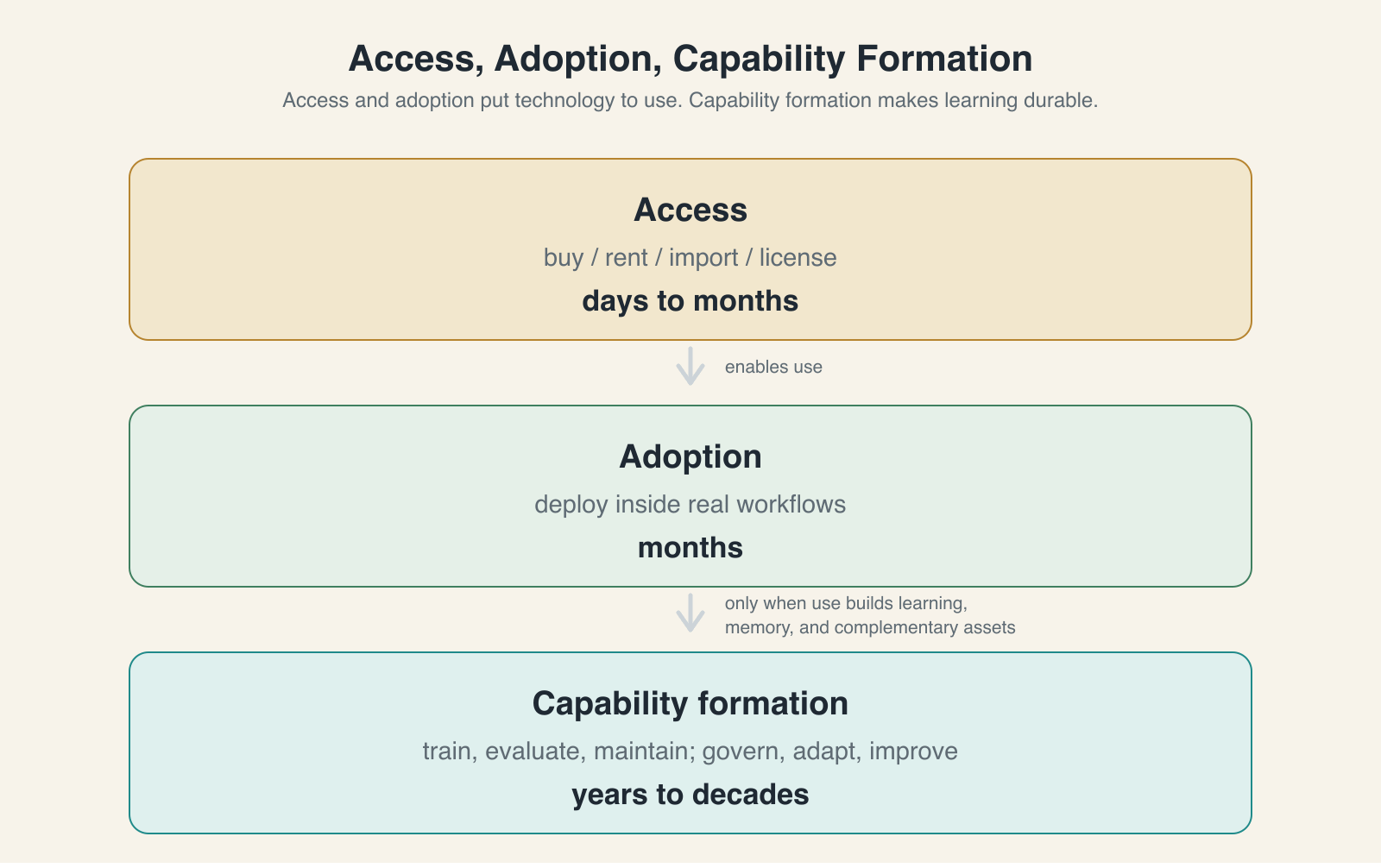
Figure 1: Access, adoption, and capability formation unfold on different timescales.
Capability compounds only when human learning survives automation, institutions retain knowledge across project cycles, and complementary assets turn both into repeated use. The next three sections take these pressures in turn: skill formation, institutional retention, and the surrounding assets that let learning compound.
The Skill Ladder Problem
The first mechanism is skill-ladder compression. Many professions produce senior judgment through junior work. Junior lawyers review documents, draft memos, and observe litigation strategy. Medical residents perform supervised diagnostic work and gradually build clinical intuition. Junior analysts clean data, prepare models, write summaries, and learn to structure analysis and communicate results through repeated practice. Software engineers often learn by writing routine code, debugging mistakes, reading existing systems, and absorbing architecture through repetition. These tasks are not glamorous, but they are developmental infrastructure.
AI intensifies a familiar automation pattern: it reaches into entry-level cognitive practice. Drafting, screening, summarizing, classification, first-pass coding, document review, translation, and routine analysis are now targets for automation, acceleration, or partial substitution. Compared with doing the same work without AI, these tasks can require less time and labor. They are also the tasks through which junior workers begin to develop senior judgment.
Automating entry-level cognitive tasks can raise productivity while compressing skill ladders. If junior workers are hired less often because routine tasks are automated, fewer people accumulate the tacit knowledge that becomes senior expertise. If junior workers are hired but asked mainly to supervise AI outputs, they may skip the messy practice through which judgment forms. If senior professionals use AI to produce more output while junior pipelines narrow, the short-term organization may become more efficient while the long-term profession becomes less capable.
In a large customer-service field study, Erik Brynjolfsson, Danielle Li, and Lindsey Raymond found that generative AI delivered its largest performance gains to novice workers, partly by transmitting practices from stronger peers. But a recent study of AI-assisted coding found measurable productivity gains for experienced developers, not early-career developers, raising the possibility of a wider skill gap. The institutional question is whether AI becomes a learning scaffold or a substitute for the practice through which judgment forms.
Further, the costs and benefits are not evenly distributed. A firm may benefit from reducing junior hiring costs today while the profession, university system, or wider economy bears the long-term cost of a thinner training pipeline. Senior workers may gain leverage if AI amplifies their productivity while entry-level pathways narrow. Educational institutions may be asked to produce practice-ready graduates without the workplace apprenticeships that used to complete the training. Skill formation is therefore not only a design problem. It is a distributional conflict over who pays to preserve the learning curve.
Historically, automation often shifted work rather than simply eliminating it. ATMs reduced routine cash handling, but branch work moved toward advisory and relationship roles. Generative AI creates a different training risk because it can remove parts of the cognitive practice layer through which senior judgment forms. If junior workers move too quickly from producing first drafts to supervising machine outputs, they may lose the baseline craft required to know when the output is wrong.
The harder skill-ladder problem is that higher-order judgment has to come from somewhere. Deming and Noray’s work on STEM careers shows that fast-changing technical fields can make skills obsolete more quickly, changing the returns to experience. AI adds a related pressure from the other direction. If the entry-level tasks through which experience accumulates are automated before new training systems emerge, the pipeline of expertise can weaken.
A country should therefore treat skill-ladder compression as more than a labor-market issue. A society cannot build AI capability only by giving people AI tools. It has to redesign the pathways through which people learn to use, question, improve, and govern those tools. That may mean new apprenticeship models, supervised AI use in professional education, simulation environments, evaluation-heavy training, and institutional roles that deliberately preserve learning opportunities even when AI reduces the time and labor required to complete some entry-level tasks.
The policy world is beginning to notice this, though the institutional response is still young. The India AI Impact Summit 2026 outcomes included an Equitable AI Transition Playbook developed with the International Labour Organization and voluntary guiding principles for reskilling in the age of AI. These are signals, not solutions. They show that workforce transition is moving from generic upskilling rhetoric toward a harder question: how to protect human learning systems while firms adopt tools that bypass parts of the entry-level practice on which those systems relied.
Without redesigned learning pathways, AI adoption may hollow out the very skill base it depends on.
Capability Dispersal
Even when skill ladders survive, capability can disperse when the people and routines holding their knowledge leave. Capability dispersal is the loss of accumulated judgment, routines, and institutional memory even when the visible system remains in place. Capability does not sit only in equipment, software, or individual talent. It sits in teams, tacit knowledge, relationships, documentation, procurement habits, maintenance practices, and the accumulated memory of what has failed before. Project-cycle funding often produces fragile capability because it builds the visible object faster than the institution around it.
A grant funds a data platform. Consultants build a system. A pilot hires technical staff. A lab acquires equipment. A ministry creates a short-term innovation unit. For a few years, the system appears capable. Then the project ends. Staff move. Contracts lapse. Documentation goes stale. Software is not updated. Procurement knowledge dissipates. The equipment remains, but the institutional memory evaporates. The capability was never the equipment alone.
Many systems compensate for this fragility through exceptional individuals. A capable public official, founder, lab head, engineer, procurement officer, or project director holds the system together through judgment, relationships, urgency, and memory. The system works while that person is present. It weakens when the person leaves.
Exceptional people matter, but they are not a capability strategy. The harder institutional question is what remains when initiative has to survive succession, budget cycles, political turnover, vendor changes, and technical drift.
An International Science Council technology profile on data infrastructure in Global South science systems makes this pattern visible across science systems. Durable data infrastructures depend less on the initial procurement of storage and more on five quieter conditions: a mandate or policy anchor, governance architecture before technical design, institutional embedding in national systems, lightweight open standards, and funding continuity. The lesson travels beyond data repositories.
Funding continuity matters more than funding spectacle. A smaller system embedded in a national agency, with stable staff, clear authority, common standards, and recurring resources, may accumulate more capability than a larger system funded as a short-lived project. The difference is not visible at launch. It becomes visible when the first staff leave, when the first integration breaks, when standards need revision, when data volumes grow, or when a new technology has to be absorbed.
DIRISA, South Africa’s Data Intensive Research Initiative is a useful example of the quieter model. DIRISA is not interesting because it offers a spectacular technology object. It is interesting because it is embedded in the country’s national cyberinfrastructure system, alongside high-performance computing and research-network capacity, rather than standing alone as a short project grant. That kind of embedding does not guarantee success, but it reduces the most common failure mode: infrastructure built as a project, then abandoned as the people and funding that made it work disperse.
Capability dispersal is especially important for middle powers and Global South institutions. Where technical labor markets are deep and well-funded, departing staff can often be replaced. Where institutions are thin, specialized knowledge is harder to rebuild. A trained engineer, data steward, procurement specialist, lab manager, or clinical informatics lead may carry a disproportionate share of capability. When that person leaves, the system may still exist on paper while its effective capacity has already weakened.
Visible infrastructure can therefore be misleading. A data center, AI lab, robotics testbed, digital platform, or research facility may signal capability. But the durable capability lies in whether the institution can staff it, update it, govern it, connect it to users, finance it through cycles, and learn from its failures.
The launch moment reveals what was purchased. Maintenance reveals what was actually built.
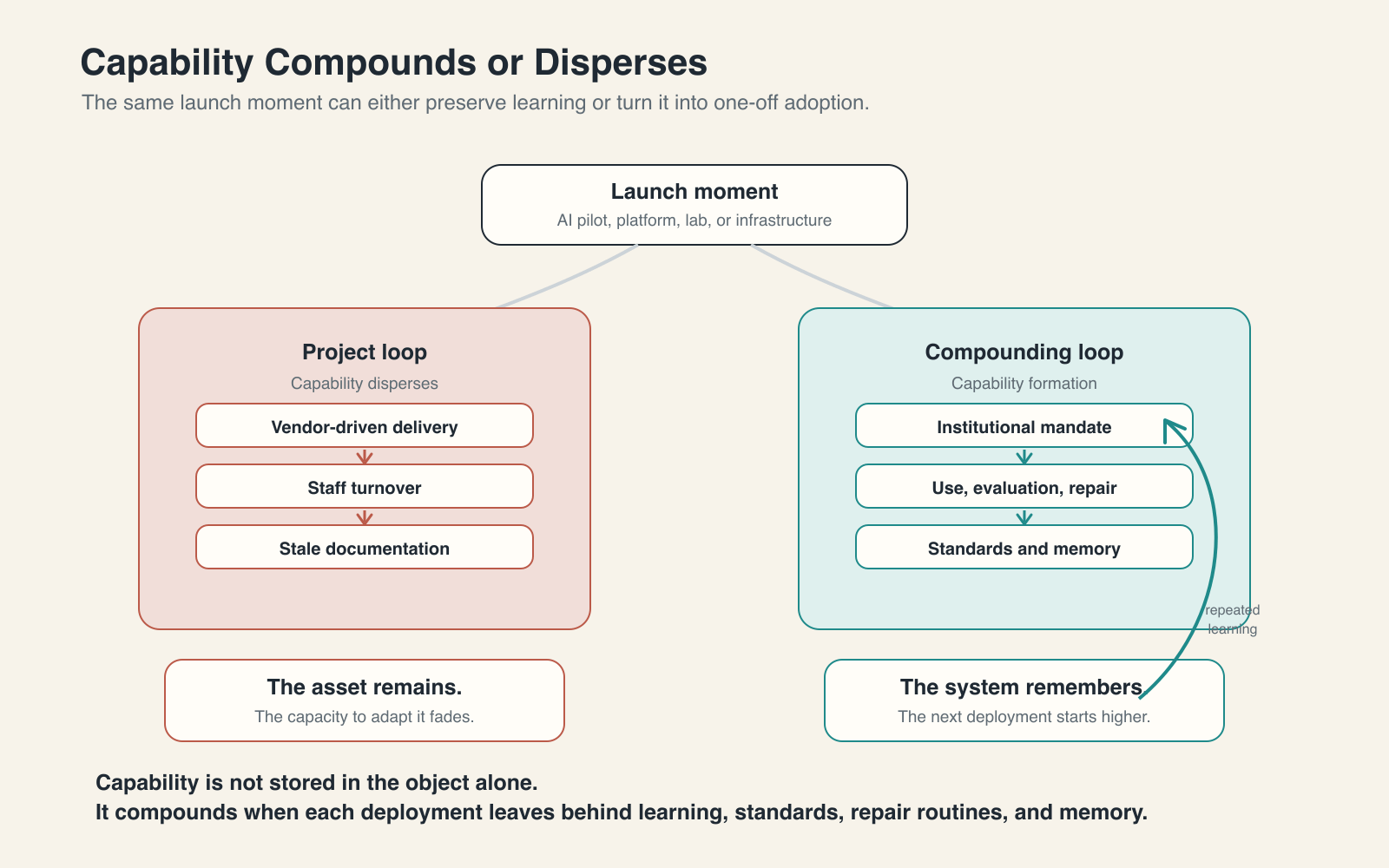
Figure 2: Capability compounds when learning and institutional memory persist across time.
Institutional Complementarity
Retaining skill and institutional memory is still not enough if the surrounding assets never assemble. David Teece used the phrase “complementary assets” to explain why firms do not profit from innovation through invention alone. They need manufacturing, distribution, marketing, service networks, standards, and other assets that allow an invention to become valuable. Douglass North made the broader institutional point: formal rules and informal norms shape whether actors have incentives to invest, coordinate, trust, and adapt.
AI follows the same logic. A model is more useful when the organization around it has clean data, domain expertise, cloud access, trained staff, workflow redesign, evaluation routines, legal clarity, and managerial capacity. Without those complements, AI adoption may produce demos, scattered pilots, or superficial productivity gains.
Consider a hospital adopting an AI diagnostic system. The visible moment is procurement: the hospital buys or licenses the tool. The public story is that AI is entering healthcare. But whether the system becomes useful depends on older and slower capabilities. Are patient records digitized and coded consistently? Can IT staff integrate the tool with existing systems and maintain the data pipeline? Do clinicians have the training and time to use it? Can the hospital validate performance in its own patient population? Does the procurement budget cover integration, updates, and maintenance after purchase?
The AI system arrives late in the story. The capability formation began years earlier, in electronic health records, coding standards, staff training, procurement choices, legal rules, hospital management, and clinical governance. The model may be new. The capability that makes the model useful is accumulated.
Complementary assets explain why adoption gaps persist across firms and sectors. Some organizations are ready to absorb AI because they have already made complementary investments. Others can access the same tool and get far less value from it. A multinational firm with structured data and in-house engineering teams can integrate AI differently from a small firm relying on off-the-shelf tools. A well-managed hospital with digital records can use diagnostic support differently from a clinic still dependent on paper files. A ministry with procurement and audit capacity can deploy AI differently from an agency buying vendor systems it cannot inspect.
Technology spreads unevenly because capability is unevenly distributed. The development problem is therefore not only access. It is absorptive capacity: the ability to recognize, adapt, use, and improve a technology inside a real organization.
Across these settings, the test is the same. Firms have to absorb technology into production; public agencies into accountable workflows; universities into training systems; science systems into research infrastructure; regulators into enforcement capacity; and labor markets without destroying the pathways through which expertise forms.
Questions like these unfold on a slower timescale than adoption questions. They are also more strategic.
Complementarity becomes clearer when AI leaves the screen. Robotics, sensors, drones, laboratory automation, and other embodied technologies require more than models and code. Simulation helps, but it does not eliminate the reality gap: physical systems encounter noise, latency, weather, surfaces, power limits, human proximity, and failure modes that virtual environments cannot fully absorb. A robot control model can be downloaded quickly. Safe test environments, maintenance routines, and operational safeguards cannot.
What Middle Powers Must Build
Capability formation is a general problem, but it is especially visible in middle powers. Frontier economies enter new technology cycles with accumulated institutional depth that can look like a natural technological advantage. Dense research universities, venture networks, supplier ecosystems, legal services, standards bodies, procurement markets, deep capital pools, and specialized labor markets were assembled over decades. When a new technology arrives, many complementary capabilities are already nearby.
Middle powers cannot assume that inheritance. Cloud computing, open-weight models, modular hardware, global APIs, and international research networks lower the cost of entering and experimenting in a technological field without reproducing the whole stack domestically. But the ability to enter a technological field is not the same as the ability to keep learning within it.
The strategic task is threefold: use external systems where access is necessary, build local depth where dependence would block learning, and turn deployment into a mechanism for accumulating judgment, talent, procurement capacity, evaluation routines, and institutional memory. An open-weight or externally developed model can therefore become a capability-building input when local institutions adapt it, evaluate it against local conditions, and retain what they learn through deployment.
The NeGD empanelment is one Indian test of this approach. Pre-qualified agencies, defined roles, and standardized rates can reduce the friction of acquiring AI expertise. The capability effect depends on what assignments leave behind: reusable documentation, stronger public teams, common evaluation routines, and knowledge that survives the contract.
The alternative is not autarky. No serious middle-power strategy can build everything domestically. The question is which capabilities must be built at home because outsourcing them would prevent learning, bargaining, evaluation, or future adaptation.
Stack-building can begin without capability automatically compounding. Data centers, model partnerships, semiconductor facilities, compute portals, and procurement pathways matter because of what forms around them: skills, suppliers, standards, evaluation routines, maintenance practices, and institutional memory. The test is whether the asset creates conditions for repeated learning.
For AI, that might mean domestic evaluation capacity that includes red-teaming and safety testing, local-language data systems, public procurement expertise, sectoral testbeds, low-cost deployment engineering, clinical and legal audit routines, compute access strategies, and training systems that preserve skill formation under automation. It may also mean procurement architectures that prevent every public agency from relearning the same deployment problem alone.
For data infrastructure, capability may mean standards, mandates, repositories, data stewards, and funding continuity. For robotics, it may mean safety protocols, maintenance technicians, local integration firms, controlled test environments, and domain-specific deployment knowledge.
The details vary by technology. Some technologies travel more easily than others, create learning faster, or require fewer complementary assets. Durable capability still depends on whether local institutions can keep learning after first adoption.
The three mechanisms now in view reinforce one another: skill-ladder compression, capability dispersal, and institutional complementarity. If skill ladders compress, fewer people accumulate the tacit judgment that becomes institutional memory. If institutional memory disperses, complementary assets are harder to operate and improve. If complementary assets are missing, adoption produces less learning, which weakens the next generation of skill formation. Capability formation is therefore not a checklist of inputs. It is a compounding system.
Capability forms where institutions create conditions for repeated learning. Systems have to be used, evaluated, repaired, adapted, and improved across time. People have to stay, institutions have to remember, failures have to be recorded, and local actors have to move from using a technology to modifying the conditions under which it is used.
Entrepreneurs often act as translators between capability layers: science and application, public missions and private products, infrastructure and use cases, local problems and global tools. But their learning compounds only when finance, procurement, standards, testing environments, research institutions, patient customers, and credible demand can sustain it.
Startups can accelerate learning. They cannot substitute for the system that lets learning accumulate.
What Compounds
The fundamental question in capability formation is what compounds. Does a deployment create learning that stays inside the institution? Does a training program produce judgment or only tool familiarity? Does infrastructure become embedded in governance or remain a project asset? Does adoption deepen local bargaining power or increase dependence on external providers?
Policy can widen access and shape diffusion through public infrastructure. Durable technological agency depends on whether the human, institutional, infrastructural, and organizational base keeps deepening after the first wave of use.
Capability formation is what turns access into agency, deployment into learning, and exceptional initiative into institutional memory.
Visual note: The diagrams in this essay are original Yukti visuals, designed from the author’s briefs and produced with AI-assisted code generation, then reviewed before publication.
Disclosure: The linked International Science Council technology profiles on data infrastructure and robotics were commissioned by the Council and co-authored by Venkat Nadella and Chandan Nagarajappa.
Earlier Essays
The Stack Beneath the Interface — why AI access rests on a deeper and unevenly controlled stack.
Operational Capacity Is AI Capability — why AI capability depends on the institutions that procure, evaluate, and maintain it.
Digital Public Infrastructure and Its Limits — where public rails can coordinate AI adoption, and where they cannot.
Further Reading
NeGD request for empanelment for AI/ML manpower augmentation and AI-driven project delivery
Brynjolfsson, Rock, and Syverson on AI and the modern productivity paradox
Deming and Noray on STEM careers and changing skill requirements
Daniotti, Wachs, Feng, and Neffke on generative AI and software-development careers