

Power Is the Convergence Layer
Why AI data centres, nuclear ambition, transmission buildout and equipment dependence now meet inside the power system.

On June 24, 2026, India’s Finance Ministry issued an order allowing four China-linked power-equipment firms with factories in India to bid for critical power projects. The order has not been publicly released, but its contents were reported by Reuters via MarketScreener, the Indian Express, the Economic Times and Business Standard.
The firms were TBEA Energy India, Nanjing Electric India, New Northeast Electric India and Taikai Electric (India). According to Reuters’ account of the order, carried by Business Standard, the exemption would last two years and would not be treated as a precedent for other companies. The Indian Express reported the same firms and the same limited treatment.
The rule being relaxed was a security rule inside public procurement. After the 2020 border clash, India required bidders from countries sharing a land border with India to register with a government committee and secure political and security clearances before competing for state contracts. The restriction sat inside Rule 144(xi) of the General Financial Rules, a procurement instrument built for a national-security problem. That procurement channel is distinct from Press Note 3, the foreign-direct-investment rule that routes investment from land-border countries through government approval.
The exemption kept the rule in place while narrowing an exception around named firms, Indian manufacturing units, critical power projects, a fixed time period, and explicit non-precedent language. The order resists easy categorization. It is tempting to treat the exemption as a China story, or as another signal of thawing commercial relations.
The more important mechanism is the pressure created when grid expansion needs equipment faster than domestic capability can supply it.
India was deciding how much dependency could be tolerated, under what conditions, for how long, because transmission expansion and power-project execution needed equipment.
Power becomes a convergence layer at that point: the grid is where separate strategies stop being separate because they begin drawing on the same constrained system.
In this case, the strategies are AI deployment, industrial expansion, renewable integration, nuclear ambition and public-service reliability. They sound separate when narrated from ministries, companies or sectors. They become connected when each needs electricity, equipment, land, water, finance, operators and rules from the same power system.
Power is not background infrastructure. It is capability infrastructure. It includes transformers, substations, transmission corridors, trained engineers, tariffs and operating rules that determine whether those ambitions can move from announcement into use.
Technology strategies meet at the grid
Technology strategy is often narrated inside sectors. AI strategy is discussed through chips, models, compute, data centres and talent. Climate strategy is discussed through renewables, storage, emissions and coal phase-down. Nuclear strategy is discussed through reactors, liability, safety regulation and private participation. Industrial strategy is discussed through manufacturing incentives, supply chains and competitiveness.
The power system experiences these strategies differently. It has to translate sectoral ambitions into load, generation, voltage, equipment, land, fuel, dispatch, finance and maintenance.
An AI data centre needs a reliable high-load connection. Renewable generation needs transmission from resource-rich regions to demand centres. Nuclear expansion needs siting, offtake, grid integration, licensing, fuel and trained operators. Thermal capacity still supplies dispatchability, peak support and system security. Industrial policy needs affordable, reliable electricity at the places where factories operate.
At the level of public debate, AI, climate, nuclear and industrial policy can look like separate agendas. At the level of the power system, they become one coupled problem with different clocks.
Electricity has this effect because it is shared in real time. A port can specialize, a factory can serve one sector, and a data centre can be built for one workload. A power system has to hold generation, load, transmission, voltage, dispatch, tariffs, maintenance and equipment inside one operating arrangement. This real-time sharing is why power becomes a convergence layer: it turns separate ambitions into a shared coordination problem.
Power has always been foundational, but the current problem is synchronization: AI demand can arrive on a software clock while transmission corridors, transformer factories, trained high-voltage direct-current engineers and tariff approvals move on slower technical and regulatory clocks; local consent moves on a political one.
Power’s real-time requirement also makes it different from semiconductors as a strategic substrate. A country can import chips, rent cloud capacity, or build a large software industry without fabricating frontier semiconductors at home. Electricity at data-centre and industrial scale has to be generated, balanced, transmitted, paid for and legitimated inside the power system that carries it.
The synchronization problem has historical cousins, though not exact precedents. Thomas P. Hughes’s history of electrification showed electric power as a large technological system embedded in institutions, standards and social context, not just as machines producing current. Marc Levinson’s account of containerization makes a similar point for logistics: the container mattered because ports, ships, standards, labour practices and trade routes reorganized around it. Paul David’s essay on “The Dynamo and the Computer” made the related productivity point: electrification mattered most after firms reorganized around it. The common mechanism is narrower: visible technologies become economically consequential only when a shared substrate can absorb and coordinate them.
Advanced economies built many of these shared substrates over decades. India is trying to expand the electrical grid, industrial equipment base and digital infrastructure at the same time.
The power-system capability layer has at least three parts. There is a physical grid of transmission lines, transformers, HVDC systems and cables; an institutional grid of interconnection rules, procurement, tariffs and standards; and a local system of land, water, consent, fuel and workforce. A strategy can fail at any one of these layers even when the others look available.
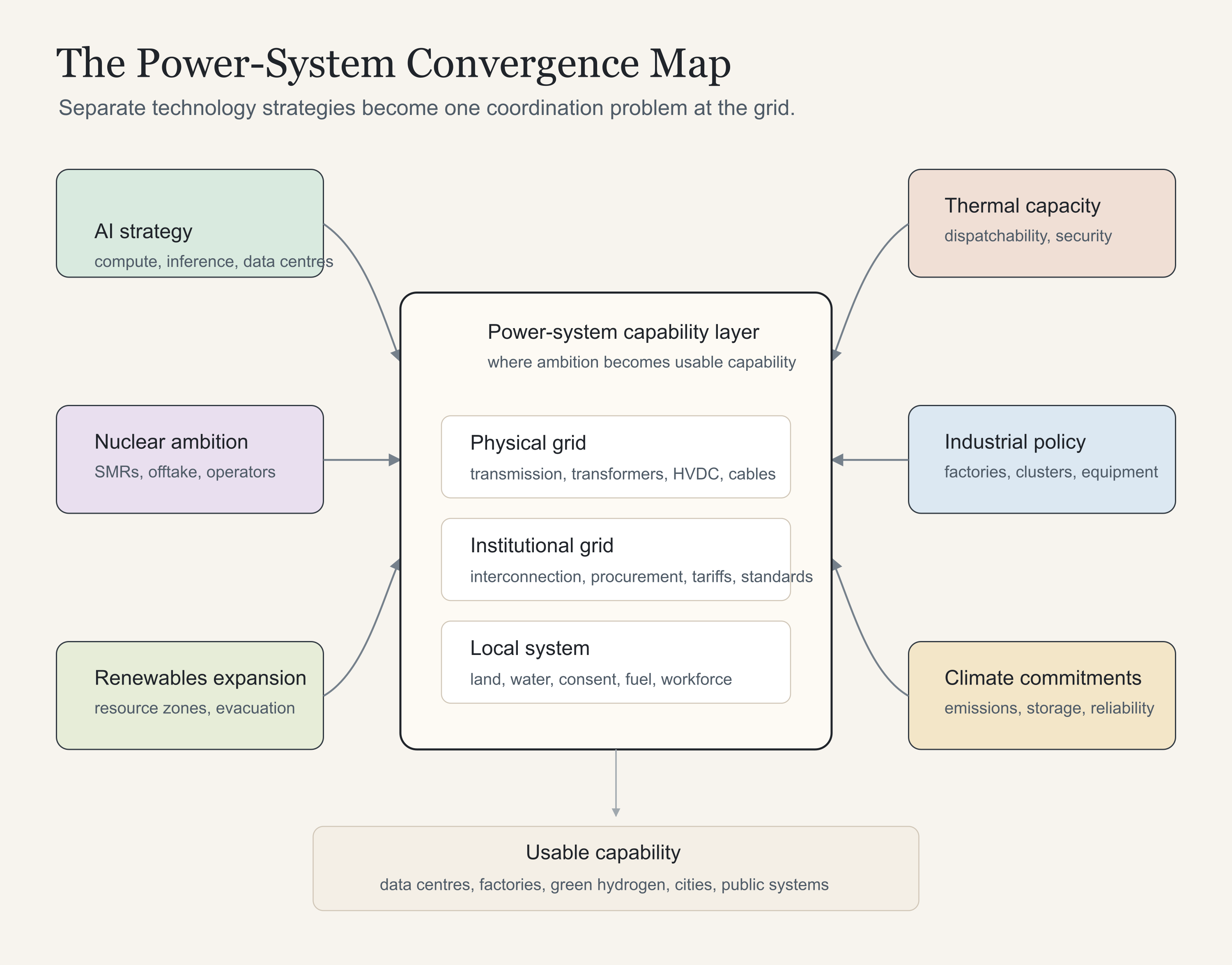
Figure 1: Separate technology strategies become one coordination problem when they draw on the same power-system capability layer.
India’s own planning documents make the grid-expansion scale visible. A March 2026 Ministry of Power backgrounder says the National Electricity Plan for transmission will expand the network from 500,000 circuit kilometres in January 2026 to 648,000 circuit kilometres by 2032. Over the same period, substation transformation capacity is planned to rise from 1,407 GVA to 2,345 GVA, while inter-regional transfer capacity rises from 120 GW to 168 GW. The plan is explicitly meant to support rising demand, renewable integration and emerging requirements such as green hydrogen. In other words, transmission planning is already one of the places where industrial, climate and technology ambitions become operational questions.
Data centres make the power dependency visible from the demand side. In March 2026, a Rajya Sabha reply by the Ministry of Electronics and Information Technology said India’s data-centre capacity had grown from about 375 MW in 2020 to around 1,500 MW by 2025. The same reply said electricity demand from data centres is estimated to reach 13.56 GW by 2031-32, and that the government is factoring the power and water needs of AI and large-scale data centres into planning.
The 13.56 GW figure mattered because it was official and bounded. Four months later, the planning number had already moved. In late July 2026, Business Standard and ETEnergyWorld reported that Minister of State for Power Shripad Naik had told the Rajya Sabha, in a written reply, that AI data centres are projected to add 26.3 GW of load by 2031-32.
The near-doubling of the planning figure is itself evidence of the problem. Digital infrastructure now has to be planned as electrical infrastructure while the demand picture is still moving. Data-centre policy reaches into power planning. Nuclear policy reaches into grid integration and offtake. Climate policy reaches into transmission, storage and dispatchability. The shared substrate is power.
Equipment dependency runs on a clock
The June 2026 exemption is most interesting when read against India’s power-equipment ambitions. It was a bounded permission for four named firms with Indian manufacturing units to bid for critical power projects despite the Rule 144(xi) security-clearance barrier.
India has domestic power-equipment firms. It has transmission companies, transformer manufacturers, engineering-procurement-construction contractors and a long history of power-sector buildout. The exemption therefore exposes a timed capability question: whether the right equipment is available at the required specifications, in the required volume, within the required schedule. A dependency can be switchable in theory and still binding in time: an alternative supplier may exist on paper, while the project waiting for a transformer still misses its commissioning date.
Transformer imports explain why a procurement exemption can matter for the grid. IEEMA’s power-transformer division reports transformer imports of about Rs 2,000 crore through direct and project-import routes, mainly from Sweden for HVDC and from China and Korea for 765 kV transformers. While historical, these figures are best read as evidence of the import pattern in specialized transformer segments rather than as a current-year capacity estimate.
The more revealing signal comes from high-voltage direct current. HVDC systems matter because they move large amounts of electricity across long distances and are central to connecting remote generation with demand centres. In May 2026, the sector trade publication Indian Infrastructure reported that the Ministry of Power had revised local-content norms for HVDC substations under the public-procurement preference framework. The roadmap starts with minimum local content of up to 30 percent until March 2028, then moves to 40 percent from April 2028, 50 percent from April 2030, and 60 percent only from April 2032 to March 2035. The components named include converter transformers, valves and control systems.
The local-content timetable is the argument about dependency. If 60 percent local content for HVDC substations is a 2032-35 target, the state is already acknowledging that some forms of power-equipment capability have to be accumulated over years. The policy sets a clock for how dependence might be reduced. Domestic capability becomes less like a declaration and more like a project schedule.
The June 2026 exemption fits this pattern. Security restrictions are designed to reduce exposure. Infrastructure schedules reveal where exposure still binds. The state’s answer was neither full exclusion nor passive openness. It was conditional access: named firms, local manufacturing presence, critical projects, limited duration, no-precedent language.
The visible politics is China-linked equipment dependence. The deeper mechanism is synchronization: security restrictions, local manufacturing targets and grid-expansion schedules are moving on different clocks.
The exemption timeline matters. A two-year exemption runs only to June 2028, when the HVDC roadmap has just reached 40 percent local content. Sixty percent local content does not arrive until 2032-35. The bridge can expire before the capability clock catches up.
The state’s real decision problem has three parts. Security policy says some suppliers require special clearance. Industrial policy says more capability should be built locally. Power planning says projects still need equipment on time. When those three clocks diverge, the state cannot solve the problem by choosing one abstract principle. It has to decide which dependency to tolerate, where to localize it, how to bound it, and what capability must be built before the tolerance expires.
Conditional access is dependency governance. The quality of that governance depends on what happens during the temporary opening. If the exception helps firms, utilities and the state build domestic capability, it buys time. If the exception merely keeps projects moving while the underlying equipment base remains unchanged, it normalizes the dependency it was supposed to manage.
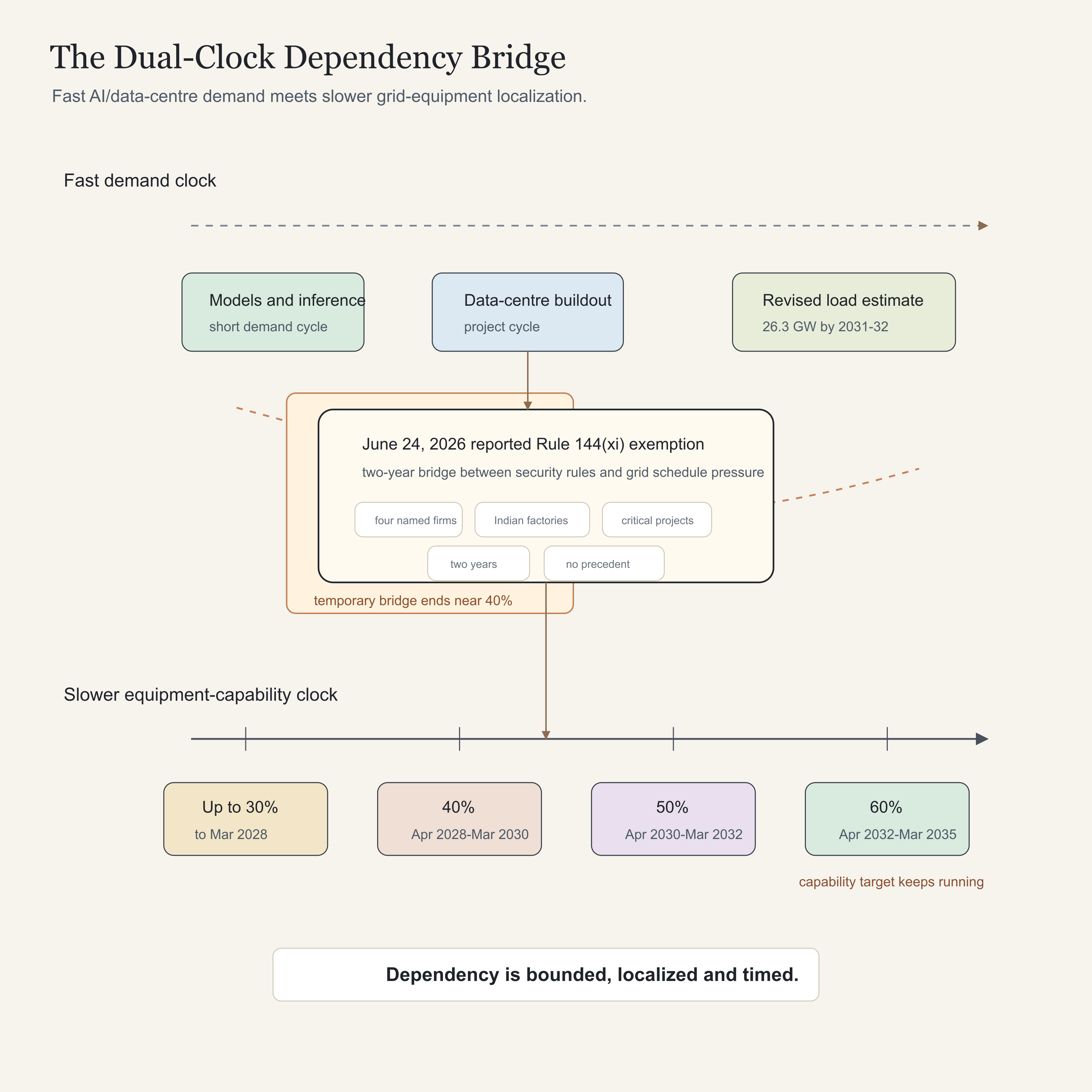
Figure 2: The June 24 exemption functions as a bounded bridge between faster AI/data-centre demand and slower HVDC/grid-equipment capability formation.
The bottleneck is more than megawatts
Most public energy debate gravitates toward generation. How much coal will be added? How fast will renewables grow? Can nuclear scale? How much storage is needed? These questions matter. They still do not exhaust the power-system problem.
Electricity has to be produced, moved and managed. It has to be transformed, balanced, dispatched, metered, paid for, maintained and regulated. A country can announce generation capacity and still fail to deliver usable power where a data centre, factory, hydrogen plant or city actually needs it.
At a substation, a power transformer is a stack of electrical steel, copper windings, insulation, bushings, tap changers, cooling systems, testing routines, transport logistics and maintenance capacity. HVDC adds another layer: converter transformers, valves, controls, filters and specialized power electronics. Each element has its own supply chain, and the slowest one sets the delivery date.
The International Energy Agency’s 2025 work on transmission-grid supply chains shows why the connective layer is becoming harder. Since 2021, it reports, prices and procurement times for essential grid components such as transformers and cables have nearly doubled. Procurement can now take two to three years for cables and up to four years for large power transformers. Direct-current cables used in long-distance transmission can face lead times beyond five years.
AI demand makes the mismatch sharper because data centres can be built faster than grids. The IEA’s Energy and AI report notes that electricity grids are already under strain in many places and estimates that around 20 percent of planned data-centre projects could face delays unless these risks are addressed. It also notes that building new transmission lines can take four to eight years in advanced economies, while waits for critical components have doubled since 2021.
The power system therefore converts digital acceleration into physical sequencing problems. A model can be trained in months. A data centre can be financed and built in a few years. A transmission corridor, transformer supply chain, HVDC system or regulatory tariff reform can move more slowly, while the whole system remains interdependent: the data centre needs the line, the line needs the transformer, the transformer needs the supply chain, and the tariff needs regulatory approval.
The uneven acceleration problem has a physical version here: software demand can move faster than the institutions and industrial systems that must absorb it. The synchronization problem is the work of aligning those clocks across electrical systems, industrial supply chains and public institutions.
India’s transmission plan is a response to those clocks. It is trying to expand network length, transformation capacity and inter-regional transfer capacity at the same time that renewable generation, industrial demand, urban demand and data-centre demand are all rising. It is also doing so inside a power system where discom finances, tariff politics, land acquisition, local consent, equipment procurement and centre-state coordination create political-economic constraints beyond demand itself.
The central constraint is whether the system can align generation, transmission, procurement, finance and demand fast enough for its technology strategies to remain credible.
Data centres turn compute into local politics
Data centres should be kept in proportion inside the global energy system. The IEA estimates that data centres accounted for around 1.5 percent of global electricity consumption in 2024, and that between now and 2030 they account for around one-tenth of global electricity-demand growth.
Global shares can hide local stress. The same IEA report projects data-centre electricity consumption rising from about 415 TWh in 2024 to around 945 TWh by 2030. The United States accounts for the largest share of the increase, followed by China; data centres alone drive nearly half of US electricity-demand growth between now and 2030. Across advanced economies, data centres account for more than 20 percent of demand growth between now and 2030; in emerging and developing economies, the share is closer to 5 percent.
The difference between advanced and emerging-economy grids matters for how the problem travels. Advanced economies are largely retrofitting mature grids for new load, new generation and new reliability demands. Emerging economies face two tasks at once: they have to expand reliable electricity while also building the digital, industrial and climate systems that now depend on it.
AI infrastructure also creates commitments before demand is fully legible. A data-centre project can lock in land, power contracts, cooling systems, grid upgrades, leases and financing assumptions years before utilisation, revenue or public benefit becomes clear. Compute does not scale through chips alone. It scales through the surrounding physical and financial system.
Geography then localizes the problem. AI-focused data centres are concentrated loads. They ask for large, reliable, high-quality power in particular places, often on timelines faster than grid planning is used to accommodating. Concentrated load can pull in gas turbines, renewable power-purchase agreements, nuclear offtake arguments, storage, backup diesel, water-use questions, local permitting, tax incentives, tariff disputes and community-benefit claims.
In the United States, the political translation is already visible. The familiar phrase would be “not in my backyard,” but the power-system problem is larger than local resistance to a disliked project. Brookings’ July 2026 work on data-centre backlash and ratepayer protection shows the issue moving through local opposition, land-use fights, electricity-rate concerns, industry pledges, utility tariff design, and state and federal regulatory action around grid connection. The details are American, but the mechanism travels.
AI infrastructure becomes public infrastructure once its costs enter power bills, water systems, land-use decisions, grid planning and local consent.
Australia’s July 2026 AI announcement gives that mechanism a more explicit policy form. The Australian Prime Minister’s media release says forthcoming standards for large data centres would require developers to support new electricity supply, cover their share of grid-connection costs, reduce load during grid stress, meet water-efficiency expectations, coordinate siting with states and territories, and include local communities. The framework is not law yet; legislation is expected in early 2027.
One policy concept for this is additionality. In this infrastructure context, it means large AI data centres are being asked to make visible, in advance, the new power, grid, water and legitimacy costs they impose on shared systems.
Strategic technologies become governable only when their full system costs are surfaced before deployment, not after the power system, regulator or community absorbs them.
The power question, then, is whether the institutions around electricity can allocate cost, security, legitimacy and reliability before infrastructure conflict arrives, not simply whether AI can secure enough supply.
For India, the political form may be less about suburban ratepayer backlash and more about allocation under constraint: which regions receive reliable capacity, which industrial corridors get grid priority, how states design data-centre policies, and whether power systems can supply the reliability that compute infrastructure requires. The reported 26.3 GW projection for AI data-centre load by 2031-32 remains modest compared with total projected national demand. It is still large enough to make those allocation choices visible.
Indian data-centre growth also raises a capacity-definition problem. HCLTech’s announcement of a planned AI data centre with Sarvam and the Government of Odisha has not yet provided public detail on capacity, grid connection, water, cooling or chip sourcing. It still sharpens the question: what kind of capacity is being installed, who can use it, who controls it, and what learning does it leave behind?
Hosting capacity is not the same as strategic capacity.
Servers, racks, power contracts, land and cooling systems can sit in India while chips, cloud-control layers, model updates, audit rights, utilisation visibility and continuity rights remain elsewhere. Hosting capacity can still matter, but only when it is connected to access, control, security standards, domestic workloads and institutional learning.
One data centre can be read through at least five policy lenses. A digital ministry may see AI infrastructure. A state government may see investment and jobs. A power ministry may see load growth and transmission planning. A climate planner may see marginal emissions and water stress. An industrial-policy official may see demand for domestic electrical equipment. A local community may see a claim on land, water, tariffs and reliability whose benefits do not automatically return to the place that absorbs the burden.
The object is the same, but the institutions around it see different problems. Power forces coordination across policy domains that are usually narrated separately.
Nuclear shows the deployment problem
Nuclear does not settle AI electricity demand by itself. It is one way to see the same deployment problem. Storage, gas, renewables and demand response would each have their own version of this test: whether announced capacity can become financeable, licensable, connectable and operable power.
India’s nuclear push shows one official response to the substrate problem. The March 2026 Rajya Sabha reply on data centres explicitly mentioned the SHANTI Act, short for Sustainable Harnessing and Advancement of Nuclear Energy for Transforming India, as part of reliable power solutions for emerging sectors such as AI and data centres. A July 2026 Department of Atomic Energy reply in the Lok Sabha places that ambition inside the Nuclear Energy Mission: at least five indigenous small modular reactors by 2033, including a 220 MWe unit, a 55 MWe unit and a small high-temperature reactor for hydrogen; present nuclear capacity rising from 8.78 GW to about 22 GW by 2031-32 as projects under implementation are completed; and a broader 100 GWe target for 2047.
Nuclear buildout depends on licensing capacity, project finance, supply chains, operator competence, fuel arrangements, public trust and offtake contracts. A July 2026 Business Standard report on a parliamentary reply says rules for private entry under the SHANTI Act are still being drafted, while reporting on Adani Power’s nuclear interest shows private ambition waiting on the ownership, operating, safety, liability, licensing, tariff and replication architecture.
NUWARD, the EDF-led French small modular reactor project, shows the same deployment problem outside India. Its public SMR page describes a Gen III+ pressurised-water design for electricity and heat for industrial clusters, data centres and high-energy consumers. Edison’s June 2026 declaration of intent with EDF, Nuward and Italian nuclear-industry actors should be read as intent rather than binding offtake. The useful tension is simple: customer participation should validate repeatable demand, not convert modular infrastructure into bespoke infrastructure.
India’s small modular reactor ambitions should be evaluated by the same test: site, customer, financing, licensing, fuel, supplier qualification, operator capacity and repeat-build pathway. Different reactor concepts imply different customers, economics, regulatory pathways and operating routines. A reactor can be modular in design and bespoke in deployment; the economics depend on preventing bespoke deployment from undoing modular design. Flexible nuclear operation also has to be engineered, regulated, operated, legitimated and paid for.
Nuclear therefore stays inside the same power-substrate question. Reactor announcements, data-centre policies, procurement restrictions and renewable targets remain upstream commitments until they pass through the power substrate. They have to become electricity, grid connections, manufacturing depth and transmission corridors before they become usable capability. The power system experiences them as competing claims on equipment, land, finance, fuel, regulation, maintenance and time.
Where technology ambition becomes usable capability
Software encourages a particular illusion. At the interface, technology feels light, scalable and instantly available. A model can be called through an API. A service can be deployed across regions. A dashboard can make a national system appear legible. Deeper layers move on slower institutional and industrial clocks.
Electricity is a physical system and an institutional one: machines, firms, rules, regulators, fuel contracts, transmission corridors, substations, tariffs, engineering standards, financial flows, maintenance routines and political authority. The whole arrangement is capability infrastructure. Model ambition matters only when the surrounding electrical, institutional and industrial systems can let models operate at scale.
The June 2026 exemption reveals a state trying to govern dependency at the exact point where security policy, manufacturing capacity and infrastructure timing collide. The order did not settle the power-equipment question. It showed that dependencies have clocks, and that aligning those clocks is itself part of state capacity.
The pattern travels beyond India. Every serious technology strategy eventually meets a layer where ambition has to become usable capability. Power forces coordination across policy domains that are usually narrated separately.
Power is the convergence layer because it is where separate ambitions lose the luxury of remaining separate.
Visual Note
The diagrams in this essay are original Yukti visuals, designed from the author’s briefs and produced with AI-assisted code generation, then reviewed before publication. They are conceptual schematics based on the sources and case materials cited here, not engineering diagrams or quantitative models. Arrows show dependency, timing, legitimacy and coordination relationships; they do not imply exhaustive causation, electrical flow, or proportional scale.
Further Reading
Thomas P. Hughes’s Networks of Power, Paul A. David’s “The Dynamo and the Computer”, and Marc Levinson’s The Box, for background on how shared substrates become economically consequential only after institutions, standards, organizations and logistics adapt around them.
International Energy Agency, Energy and AI, for the strongest current synthesis of data-centre electricity demand, grid delays and the AI-energy link.
Brookings’ data-centre pieces on AI power backlash and ratepayer protection, read alongside Australia’s July 2026 AI and data-centre standards announcement, for the current policy layer where compute demand meets electricity rates, utility regulation, additionality and local legitimacy.
GMF’s “Decarbonizing Without Dependencies”, for a European strategic-policy mirror on clean technology, energy nodes, industrial competitiveness and dependence management.
Takshashila’s “The AI Investment Cycle” and reporting by the Wall Street Journal and Bloomberg Law on the proposed Nvidia / OpenAI / SoftBank Ohio data-centre financing structure, for background on how AI infrastructure can create long-lead physical commitments before revenue certainty arrives.
The U.S. Department of Energy’s Generation III+ Small Modular Reactor Program, as a comparator on SMR deployment teams, licensing, supply-chain and site-preparation gaps.
Sources and Case Materials
Opening case and procurement rule:
Reuters account via MarketScreener, “India allows four Chinese-linked power equipment firms to bid for government projects”.
Indian Express, “Chinese power equipment firms get two-year exemption for government tenders”.
Economic Times, “India allows 4 China-linked firms to bid for power projects”.
Business Standard, “Govt allows 4 China-linked power equipment firms to bid for key projects”.
Government of India, Rule 144(xi) procurement restriction announcement.
Government of India, Press Note 3 FDI policy amendment announcement.
India power, transmission and data-centre planning:
Ministry of Power, National Electricity Plan transmission backgrounder.
Ministry of Electronics and Information Technology, Rajya Sabha reply on data centres, AI and power planning.
Business Standard, reported parliamentary reply on 26.3 GW AI data-centre load by 2031-32.
ETEnergyWorld, reported Power Ministry written reply on AI data-centre load, transmission investment and under-construction capacity.
Transformer, HVDC and grid-equipment evidence:
IEEMA, Power Transformer Division.
Indian Infrastructure, Ministry of Power revises local content norms for HVDC substations.
International Energy Agency, transmission-grid supply-chain note.
Data-centre electricity demand and local-politics context:
International Energy Agency, Energy and AI: Executive Summary.
Brookings, Tom Wheeler, “Data center backlash signals a fight over AI power”.
Brookings, David M. Klaus and Mark MacCarthy, “The pledge to protect ratepayers from AI data center costs needs enforcement”.
Australian Prime Minister, “AI in Australia’s interests”.
Nuclear context:
Department of Atomic Energy, “Parliament Question: Nuclear Energy Mission for Viksit Bharat”.
New India Samachar, SHANTI Bill, 2025 backgrounder.
Business Standard, “Rules for pvt entry into nuclear power under SHANTI Act being drafted: DAE”.
Indian Express, “Adani Power weighs nuclear development at two former Jaiprakash Associates’ thermal plant sites, waits for ‘rules’”.
NUWARD, “Our SMR solution”.