

The Uneven Acceleration Problem
AI makes generation faster. Absorption still moves at institutional speed.

Generation Moves First
DORA’s 2025 report on AI-assisted software development found that roughly 90 percent of surveyed technology professionals were using AI at work. In DORA’s model, higher AI adoption was associated with higher software delivery throughput. Teams were able to move more changes through the delivery system.
DORA also found higher software delivery instability: the kind of failed deployments, emergency fixes, and unplanned rework that appear after software reaches users. More output did not automatically mean more reliable software.
The delivery-instability tension matters because software delivery is not only the act of writing code. AI can help a developer produce new code, but the software team still has to review it, test it, merge it, secure it, deploy it, monitor it, roll it back when needed, and maintain it after the original author has moved on.
The organizational setting around the tool matters. Teams with clear AI policies, usable internal data, strong version control, testing discipline, and good internal platforms are better placed to turn AI assistance into real gains. Teams without those routines may simply produce more changes than their review, testing, and deployment systems can handle.
This is the uneven acceleration problem.
The visible symptom is faster output. The deeper organizational issue is the work required to judge and use that output. The current wave of generative AI makes the pattern unusually visible because it reduces the cost of producing code, documents, summaries, reports, tickets, and recommendations. But it does not remove the need to decide whether the output is good enough, who is allowed to rely on it, and what happens if it is wrong.
The burden does not disappear when output becomes cheaper. It moves to the people and organizations asked to act on the output.
Yukti argued, in earlier work, that visible interfaces often sit on deeper stacks, and that real capability is built over time. Uneven acceleration adds a temporal dimension to those arguments. The issue is no longer only where capability sits in the system: it is how fast each layer moves, where the work of judgment accumulates, and whether the slower layer is learning or only becoming busier.
The Burden Moves Downward
Software makes the burden easy to see because generated output has to pass through review, integration, testing, and maintenance before it becomes part of a working system.
Large open-source repositories are a demanding test of AI-assisted productivity because they are real systems with existing users, maintainers, architecture, review standards, and accumulated context. In the METR randomized trial, experienced developers completed real issues from mature repositories; before work began, each issue was randomly assigned to either allow or disallow AI tools. The developers expected AI to make them faster and often felt that it had done so. Measured task completion showed the opposite: in this setting, AI-allowed tasks took about 19 percent more time.
A first attempt can appear quickly while the whole task still takes longer. Mature-codebase work includes reading old code, understanding design constraints, testing the change, checking side effects, and taking responsibility for the result.
Ordinary office work shows a similar burden shift. Researchers at BetterUp Labs and the Stanford Social Media Lab described AI-generated workplace output that looked polished but lacked the substance needed for the recipient to use it. In survey results reported in Harvard Business Review, 41 percent of respondents said they had received such work, with each instance costing roughly two hours of rework.
The problem is not that every AI-generated memo is bad. It is that cheap production can hide expensive reception. The sender saves time by generating something plausible. The recipient spends time reconstructing intent, checking claims, asking for missing context, and correcting work that should have arrived clearer in the first place.
AI adoption often begins with the tool arriving before the surrounding work has been redesigned. Employees are encouraged to use AI before managers know what good AI-assisted work looks like. Teams produce more candidate output before review systems, standards, and escalation routines adapt.
The generation layer is easy to see. The absorption layer is easy to leave under-resourced.
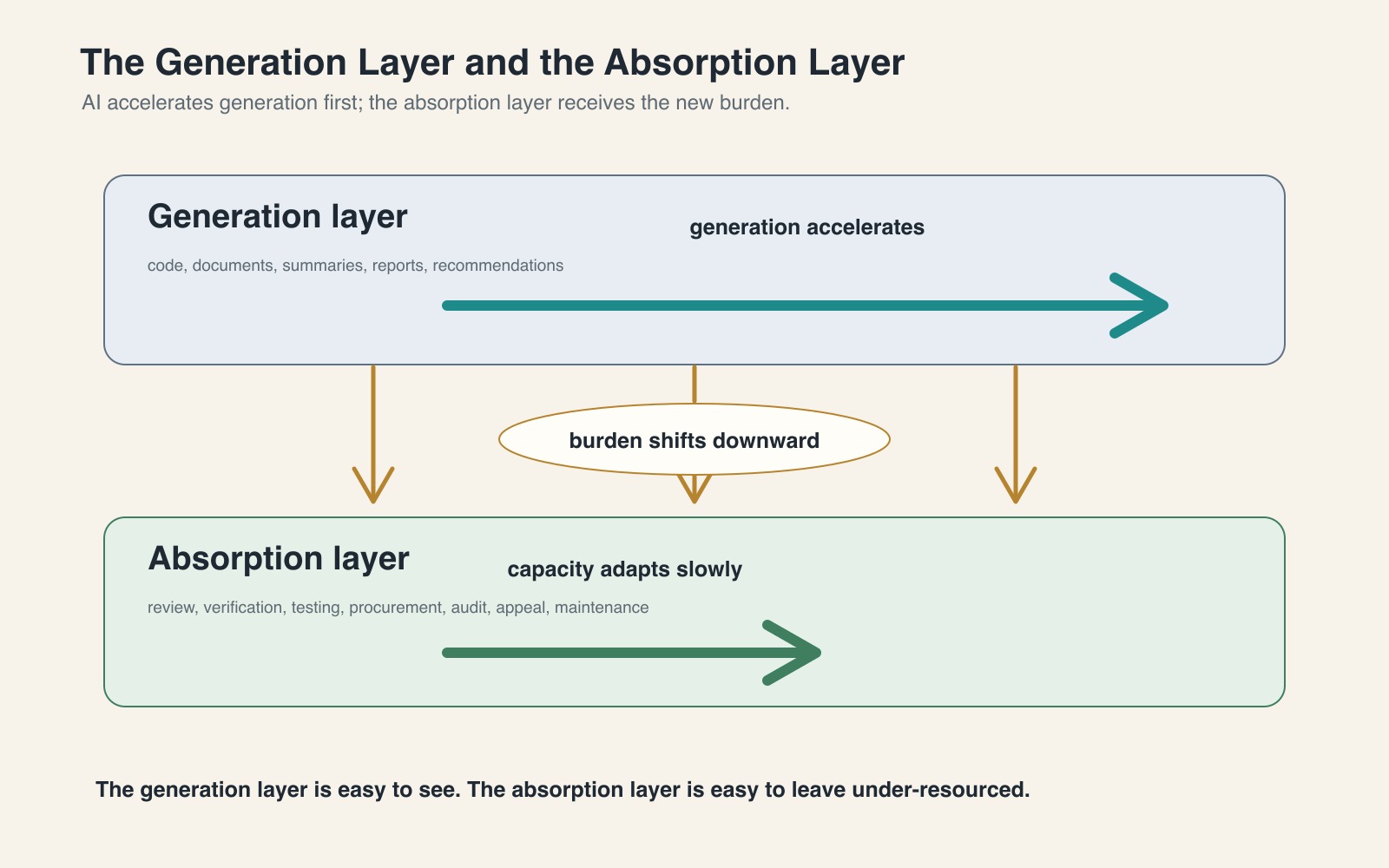
Figure 1: The Generation Layer and the Absorption Layer
Verification Becomes Institutional
Verifying an AI output is not just a technical step. It is an organizational act. Someone has to know the standard being applied, the evidence needed to accept the answer, the authority to approve it, the cost of error, and the record that will exist if the decision is challenged later.
AI can assist parts of verification. It can help write tests, summarize documents, search logs, detect anomalies, and compare claims. But final responsibility rarely sits inside the model. It sits in the organization that uses the output.
Operational Capacity Is AI Capability made the responsibility chain the main object: AI outputs become consequential through hospitals, courts, schools, welfare agencies, vendors, integrators, and frontline officials. Uneven acceleration adds the temporal pressure. When outputs multiply faster than organizations can verify, contest, escalate, and learn from them, verification becomes institutional rather than merely technical.
Arvind Narayanan’s ICML 2026 keynote makes the same point in economic language. Model capability becomes value only when it is joined to downstream reliability, integration, tacit knowledge, regulation, evaluation, and organizational adaptation. The model is upstream; value appears only when the surrounding system can use it well.
In public administration, those surrounding capacities are tied to legitimacy. If an AI-assisted eligibility system wrongly denies a benefit, the agency still has to preserve the record, explain the basis of the decision, route an appeal, assign responsibility, correct the harm, and learn from the failure. The output may be fast. Accountability is procedural.
Two common shortcuts fail here. The first is “human in the loop.” A reviewer without time, authority, domain knowledge, technical documentation, or escalation rights is not a meaningful control. The second is one-off training. OECD’s work on skills in the AI age treats AI not as a single shock to jobs, but as an uneven change in tasks across occupations, sectors, and regions. That makes adaptive learning institutions more important than one-time skilling.
Uneven acceleration describes what happens when demand for operational capacity rises faster than operational capacity itself. Operational capacity is the broader institutional ability to procure, evaluate, govern, and operationalize complex systems. The absorption layer is that capacity under pressure: the work of turning new outputs into reliable, accountable, and learnable practice.
AI is not the first technology to make one part of work easier before the surrounding routines catch up. Word processors made drafting easier before editing improved. Email made sending easier before filtering improved. Spreadsheets made modeling easier before model auditing improved. AI is a faster, more opaque, and more general version of that familiar pattern.
Organizations therefore need a simple way to ask whether they are absorbing AI or only accumulating more output.
A useful absorption test has four parts: what AI made cheaper to generate; who verifies the output and with what authority; where responsibility moves if the output fails; and what record improves the next deployment.
The test is deliberately modest. It does not require a new metric, a policy blueprint, or a formal audit regime before any AI use can begin. It asks whether an organization can see the work that moved. If nobody can name the verifier, the escalation path, the record of failure, or the learning loop, the institution is not absorbing AI. It is only receiving more output.
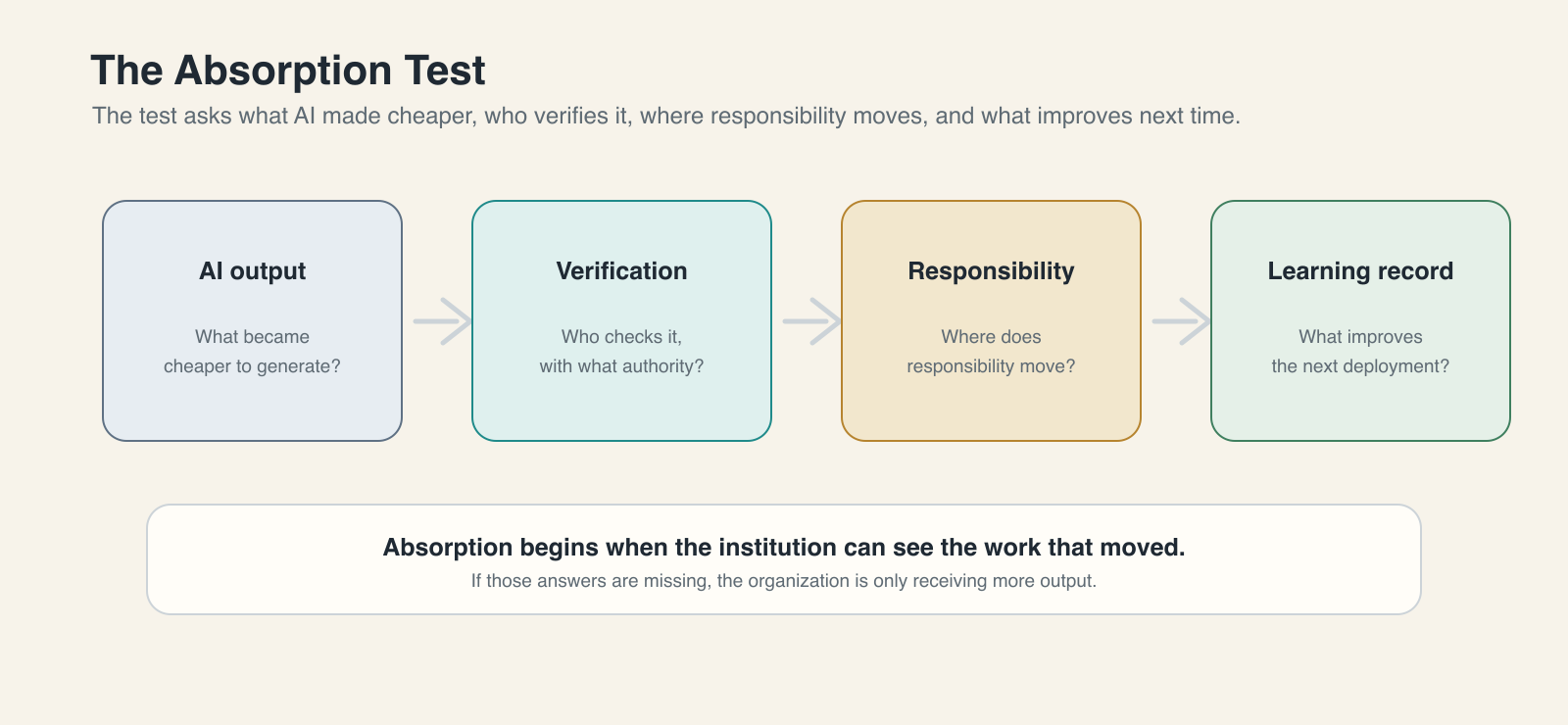
Figure 2: The Absorption Test
Governments Move On A Slower Clock
Public institutions face uneven acceleration under higher-stakes conditions. A July 2026 preliminary report of the UN’s Independent International Scientific Panel on AI is useful here because it separates access from value. Infrastructure, cloud services, and APIs may determine who can use AI, but the report stresses that adoption creates value only when it is joined to skills, data quality, workflow change, experimentation capacity, and institutional context.
That distinction matters for government. A ministry can gain access to AI tools faster than it can build evaluation routines, train staff, improve data quality, redesign workflows, or preserve accountability when errors occur. The clock that governs access is not the clock that governs public learning.
Public agencies cannot treat AI adoption as a simple tool rollout. The UN panel also notes that real-world effectiveness is rarely measured well, and that many countries lack the technical expertise to assess the most capable frontier models. The ability to evaluate AI is itself unevenly distributed.
The first slow clock is measurement. The OECD’s 2026 Digital Government Outlook found that only 10 of 36 OECD countries measure the impact of government AI use cases in any form. Some measure across sectors, some across government, and many do not measure systematically at all. That matters because deployment is easier to announce than learning is to prove.
The second slow clock is operational capacity. The UK’s National Audit Office found that many public bodies were piloting or planning AI while skills gaps, recruitment difficulty, data limitations, and unclear benefit measurement constrained responsible uptake. The problem was not a lack of interest. Agencies were trying to use fast-moving systems while their own evaluation, staffing, and governance routines were still catching up.
Technology-law scholars have long described a related pacing problem: emerging technologies often move faster than legal and regulatory systems can respond. Uneven acceleration is the broader institutional version of that problem. Regulation is one absorbing layer. Review systems, procurement routines, audit institutions, evaluation bodies, training systems, and professional judgment are others.
Some institutional lag is temporary. Workflows adapt, training improves, procurement offices learn, and evaluation routines become more sophisticated. But public institutions are not slower only because they are inefficient. They are slower because they carry duties that should not update at software speed.
Public agencies cannot revise rights, obligations, appeal routes, or accountability structures with every product update. Courts, auditors, regulators, ministries, hospitals, and schools carry inherited responsibilities. Their procedures encode legitimacy, not just friction.
The mismatch becomes visible when an AI tool enters a public workflow before the surrounding institution is ready for it. A tool can be procured in a year, piloted in a quarter, and updated continuously. The appeal process that must handle errors may still be paper-based, legally constrained, under-staffed, or spread across offices that do not share data well.
The system moves at software speed; the institution absorbs at procedural speed.
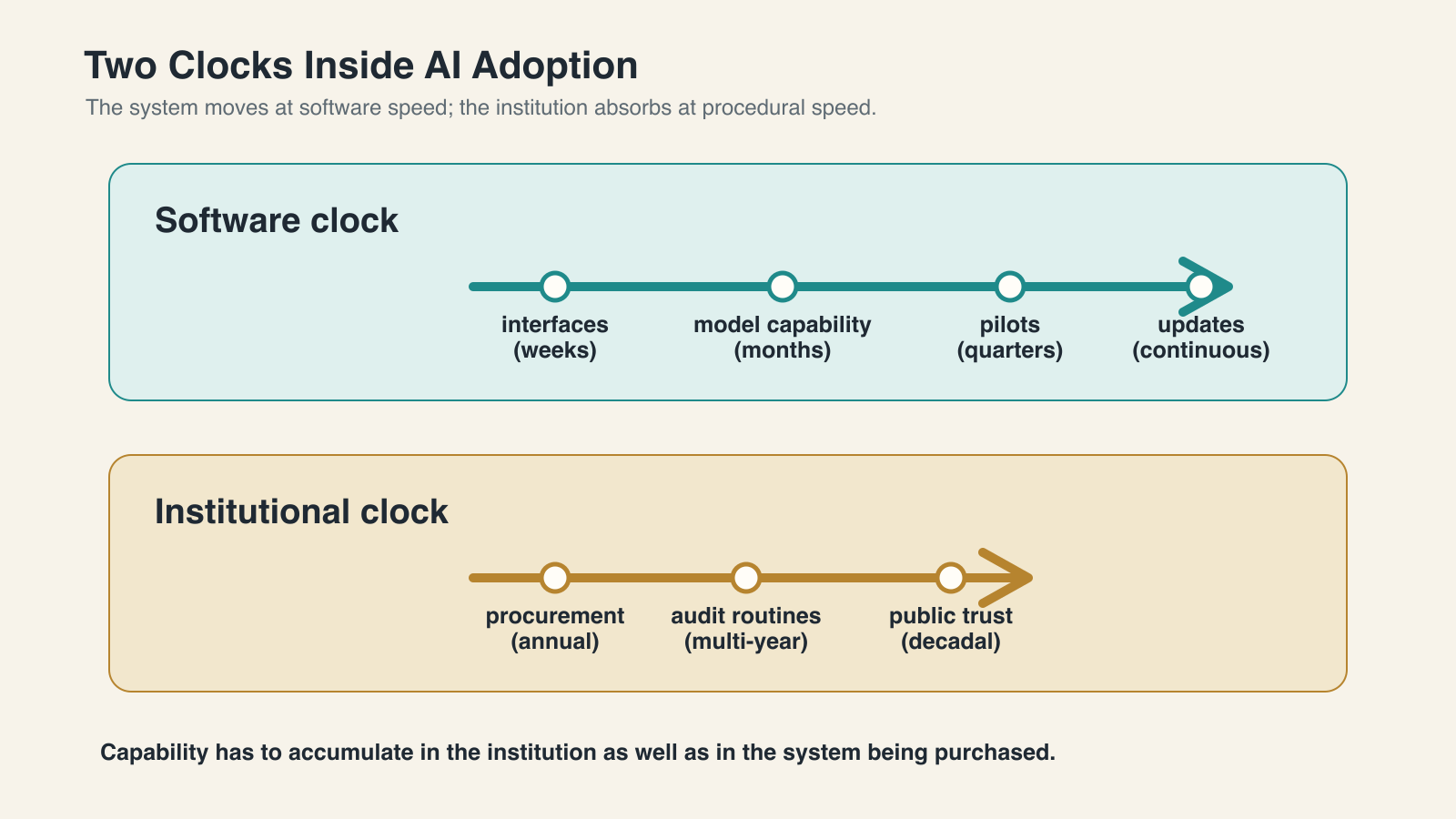
Figure 3: Two Clocks Inside AI Adoption
Institutional time is one reason AI governance cannot be reduced to model policy. A model may become safer, cheaper, or more capable with each release. The public institution using it may still lack the routines to integrate the model’s use into its procedures. Capability has to accumulate on both clocks: in the system being purchased, and in the institution expected to use it.
Access Travels Faster Than Absorption
Uneven acceleration has a national version. Countries can obtain AI tools faster than they can build the institutions that turn those tools into capability.
For middle powers, this gap is especially sharp. Models, APIs, cloud services, developer tools, and enterprise platforms can be imported or rented. Data governance, procurement routines, audit capacity, evaluation standards, appeal routes, and public-sector technical judgment have to be built locally.
A country can rent compute before it has mature data-quality standards. It can expand AI access before it has teams experienced in procurement, public-sector technical units, evaluation bodies, and audit routines that convert access into institutional learning. Access can move quickly because it is often purchased. Absorption moves slowly because it has to be practiced.
Access creates a second question for middle powers: who can change the terms later? Countries that depend on foreign models, cloud infrastructure, and data pipelines may gain AI access while retaining limited influence over standards, safeguards, pricing, model behavior, and local fit. The supplier may control the model, the cloud service, the data pipeline, or the interface through which the system is used.
The strategic question is whether a country can turn imported access into local learning fast enough.
The dynamic trilemma frames this setting. Middle powers want frontier access, low-cost efficiency, and enough sovereignty to avoid strategic exposure. Uneven acceleration makes that tradeoff operational. Even when access is available, the institutions that evaluate and govern the technology may not move at the same speed. The faster a country imports AI tools, the more important it becomes to build the capabilities around access.
The AI race is not one race. Frontier labs may race to improve benchmark capability, while states may race to diffuse good-enough AI through industry, create open-model ecosystems, strengthen domestic chip demand, or build evaluation capacity. China’s AI Plus strategy treats the strategic object as the speed at which AI becomes usable across production, services, governance, and infrastructure, not just the frontier model.
Benchmark races, diffusion races, and institution-building races do not move together. Benchmark capability can shift in months. Industrial absorption, public-sector evaluation, and domestic participation take longer.
The capabilities that matter are easy to miss because they do not look like frontier technology. They look like audit manuals, data validation standards, procurement templates, evaluation benchmarks, incident logs, staff training, and institutional memory. India matters here because it is trying to widen access while building parts of this absorption layer at the same time.
India’s Absorption Test
India is a live test of whether faster access can be converted into public-sector learning: whether compute, data, procurement, evaluation, and audit capacity are beginning to compound together.
Recent initiatives all point in the same direction: India is trying to widen access while building data, evaluation, and procurement capacity around it. The IndiaAI Mission and Compute Portal and AIKosh launch address access; the IndiaAI-Karya MoU points toward data and evaluation; the NeGD AI/ML empanelment creates a procurement channel. The test is whether these pieces become a learning system, not only adoption channels.
Audit gives the sharpest institutional test. In April 2025, the Comptroller and Auditor General issued an Artificial Intelligence Strategy Framework. The CAG is preparing to use AI inside its own audit work, including institutional knowledge systems and AI-assisted report drafting. It is also preparing to audit AI systems used across government. The same institution is therefore accelerating part of its own work while taking on a harder audit object.
The CAG case places both speeds inside one institution. The generation layer accelerates: AI can help draft, analyze, and search institutional knowledge. The absorption layer becomes more burdened: the audit institution must also learn how to inspect AI systems used across government.
Audit institutions matter here because they are memory machines. At their best, they convert scattered errors, weak documentation, procurement failures, and implementation gaps into reusable standards for the next round of public action.
Auditing government AI systems is slower because it is not the same as checking whether software was purchased or deployed. An auditor may need to understand the data pipeline feeding the system, the procurement record that specified performance claims, and the model documentation available to the agency. The audit may also need to follow decision logs, responsible-AI controls promised by the vendor, and the route through which an affected citizen can challenge an error.
The boundary between technical performance and administrative accountability becomes part of the audit object. A model may produce statistically acceptable results while still failing a public purpose if its errors are not visible, appealable, or properly assigned. A procurement file may show that an AI system was delivered, while the harder audit question is whether the agency can evaluate, contest, and improve the system after delivery.
Middle-power capability is often built through this kind of institutional accumulation. Not one model release, not one national champion, and not one compute target, but the slower growth of public institutions that can evaluate, audit, procure, and learn from the systems the country adopts.
India’s AI strategy will be judged partly by its models, compute, startups, and applications. It should also be judged by whether its public institutions become harder to fool, better at specifying what they need, and more capable of saying no to systems they cannot evaluate.
What Generation Leaves Behind
The language of AI strategy often favors speed. Countries are told to move quickly, firms to adopt, workers to use new tools, and public agencies not to fall behind.
Speed is not the same as capability. Faster generation is valuable when it leaves stronger systems behind. It is dangerous when it leaves only more outputs for the same weak review, evaluation, procurement, and accountability routines to absorb.
AI-assisted coding is progress when review, testing, security, and maintenance improve with it. Public-sector pilots build capability when agencies measure impact, retain learning, and improve the next deployment. Compute access deepens capability when it is joined to evaluation, procurement, audit, and data-governance capacity.
Uneven acceleration is therefore not an argument for slowing everything down. Some layers should move quickly. Others should move deliberately because they carry responsibility, legitimacy, safety, and the risk controls that let learning compound. AI lowers the cost of producing candidate knowledge: code, analyses, reports, designs, recommendations, and explanations. The strategic task is to build institutions capable of absorbing those outputs at the pace they are created.
For middle powers, this may become one of the central tests of AI strategy. Frontier access matters. Low-cost efficiency matters. Domestic capability matters. But the everyday machinery that turns access into judgment matters just as much: procurement teams, evaluation bodies, audit institutions, data stewards, public-sector technical units, and professional routines that learn over time.
A strategic mistake follows from measuring adoption more easily than absorption. A government can count AI pilots, compute credits, users, and deployments before it can show that evaluation routines, procurement memory, audit capacity, data stewardship, and professional judgment are compounding.
The generation layer can make an organization or country look more capable before it actually is. The absorption layer decides whether the appearance becomes real.
Visual note: The diagrams in this essay are original Yukti visuals, designed from the author’s briefs and produced with AI-assisted code generation, then reviewed before publication.
Further Reading
Arvind Narayanan, “What will be left for us to work on?” and the companion essay - ICML 2026 keynote and essay arguing that AI’s economic impact depends on downstream reliability, integration, tacit knowledge, regulation, evaluation, and organizational adaptation, not only model capability.
Gary Marchant, Braden Allenby, and Joseph Herkert, The Growing Gap Between Emerging Technologies and Legal-Ethical Oversight, and Lyria Bennett Moses, “Recurring Dilemmas” - technology-law scholarship on the pacing problem and the recurring difficulty of adapting legal systems to technological change.
Sources and Case Materials
DORA, State of AI-assisted Software Development and METR on early-2025 AI tools - software evidence on throughput, stability, and the gap between perceived and measured speed.
Harvard Business Review on AI-generated workslop - workplace evidence on burden shifting to recipients.
UN Independent International Scientific Panel on AI, Preliminary Report - July 2026 preliminary evidence on uneven adoption, access versus capacity, and underdeveloped evaluation.
OECD, Skills in the AI Age and Digital Government Outlook 2026 - workforce and public-sector evidence on uneven absorption.
NAO, Use of Artificial Intelligence in Government - UK public-sector capacity and skills constraints.
CAG AI Strategy Framework - Indian audit-capacity evidence for AI in government.
PIB on IndiaAI-Karya MoU - IndiaAI, AIKosh, model evaluation, and dataset standards.
CSET translation of China’s AI Plus policy - Chinese policy evidence on industrial diffusion, open ecosystems, and AI adoption targets.