

The Dynamic Trilemma of Technology Strategy
Control, frontier access, and low-cost efficiency pull against one another. Capability changes the trade-off over time.

The Sovereign AI Signal
In June 2026, Sarvam announced that it had raised $234 million in the first close of a $300 million Series B, at a post-money valuation of $1.5 billion, with HCLTech investing $150 million as lead strategic investor. The sovereignty signal was explicit rather than inferred. In the same announcement, Sarvam described itself as “India’s full-stack sovereign AI company,” and HCLTech framed the investment as a step toward a trusted, globally competitive Indian AI ecosystem.
The framing is understandable. Sarvam sits at the point where several Indian ambitions meet: domestic foundation models, Indian-language capability, enterprise and government applications, and the broader IndiaAI push toward indigenous AI capacity.
A national AI company is a signal. National AI capability is the harder test.
The phrase sovereign AI can make several different claims at once: domestic models, local-language systems, data control, compute access, enterprise deployment, public-sector assurance, and some degree of national agency over a technology stack. That is why it has to be tested layer by layer.
The harder question is what the company, the mission, and the surrounding ecosystem leave behind. The useful signs would be trained engineers, stronger firms, better datasets, local benchmarks, stronger evaluation routines, deeper procurement competence, and public institutions that can absorb AI responsibly. The weaker outcome would be symbolic sovereignty: the announcement standing in for the capability, while the deeper learning, infrastructure, market depth, and operational judgment remain thin.
Sovereign AI now names a strategic problem as much as a technology ambition. For a country like India, the question is how to pursue it while moving through a trade-off between technological sovereignty, frontier access, and low-cost efficiency.
Most countries want all three. They want control: enough domestic capacity and leverage that critical systems cannot be withdrawn or dictated from outside. They want frontier access: the ability to use the best models, chips, cloud systems, and research networks. And they want low-cost efficiency: AI cheap enough to diffuse through firms, universities, public agencies, hospitals, and small enterprises.
AI makes the tension difficult to hide. Control often raises cost. Frontier access often requires dependence. Low-cost efficiency often rests on global specialization and hyperscale systems that weaken domestic control. Control, frontier access, and low-cost efficiency pull against one another; together these pressures form a trilemma of technology strategy.
Three Objectives, One Constraint
Technological sovereignty is often misread as self-sufficiency. Countries rarely control every layer of the AI stack. Chips depend on design tools, lithography systems, fabrication knowledge, and supplier ecosystems. Models depend on compute, data, engineering teams, and evaluation systems. Deployment depends on institutions that can procure, evaluate, govern, and maintain what they use.
Technological sovereignty means agency inside interdependence: the ability to shape the terms on which critical systems are accessed, governed, and improved. In operational terms, this means critical systems cannot be withdrawn without warning; public institutions can audit what they deploy; local firms can build on reliable infrastructure; and the state has options other than accepting whatever external providers offer.
Frontier access matters for the opposite reason. Countries learn by working with the systems that define the frontier. Firms learn by integrating with leading platforms. Researchers learn by working with powerful tools. Public agencies learn by deploying and evaluating real systems before a fully domestic stack appears.
For middle powers, low-cost efficiency is central. AI that is affordable for a major American platform company may be expensive for an Indian startup, a state government, a public university, or a small hospital. If access is too expensive, diffusion narrows. If diffusion narrows, learning narrows. If learning narrows, capability formation slows. Low-cost access can become one of capability’s preconditions, even though it never guarantees capability by itself.
The difficulty is that the three objectives pull against one another. A country can push toward control and frontier access, but it must absorb the cost of subsidies, redundant infrastructure, industrial policy, and long-term institutional funding. A country can pursue control and low-cost efficiency, but it may have to accept domestic systems below the frontier. A country can pursue frontier access and low cost, but only by leaning heavily on external platforms, chips, model ecosystems, and capital.
The static version of the trilemma describes this constraint: each objective makes the others harder to maximize. The dynamic version asks how countries reshape the constraint over time. Capability changes the trade-off itself. A country that builds evaluation capacity, procurement memory, data infrastructure, technical teams, and supplier depth still faces the trilemma. Capability does not erase the constraint. It changes the terms on which the next trade-off is faced.
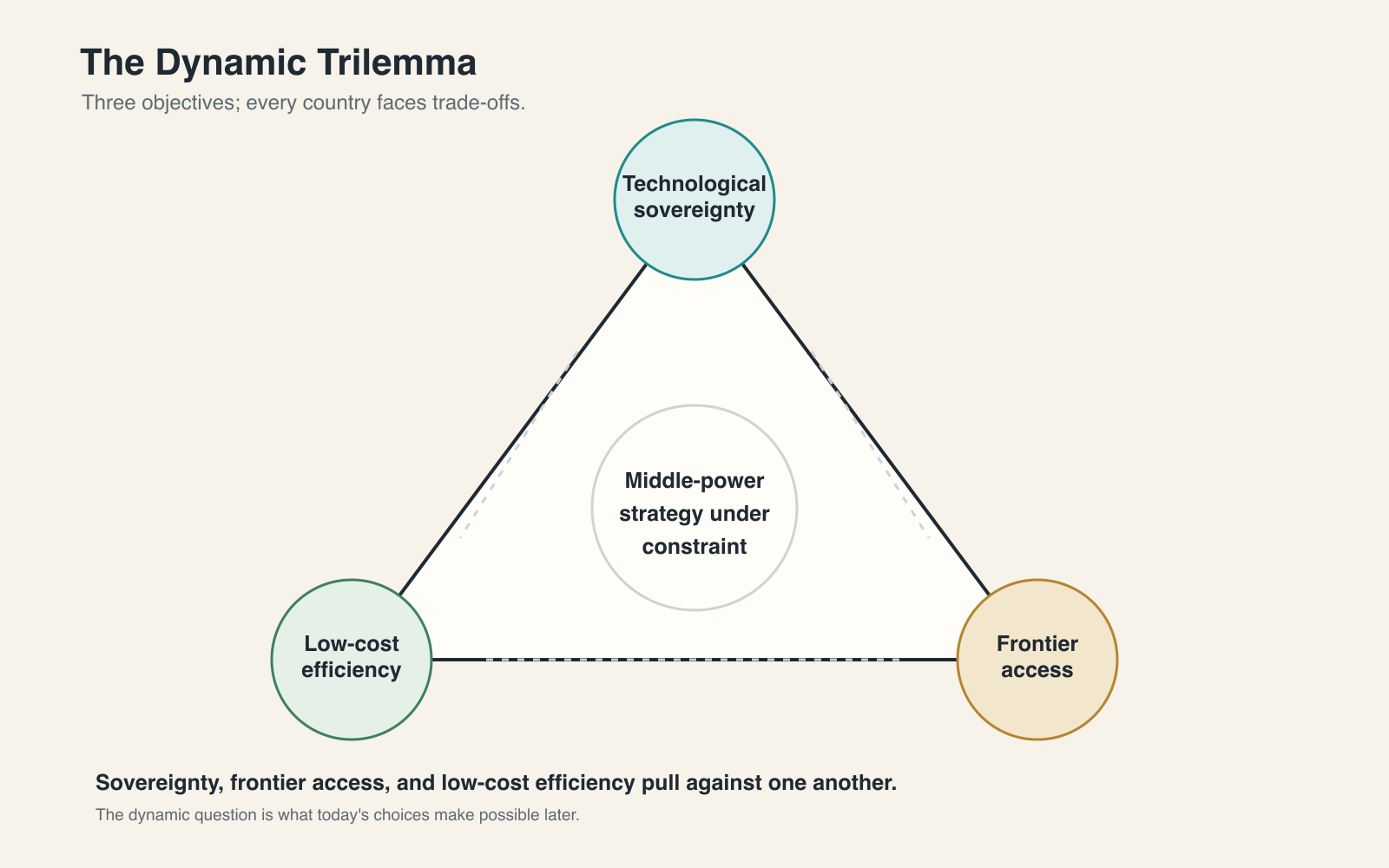
Figure 1: Three objectives; every country faces trade-offs.
Trade-Offs Change Over Time
Countries inherit a position before they choose a strategy: a chip industry they lack, a services sector they have, an energy grid under strain. Then they try to alter the choices available later.
The sovereignty debate tends to map positions. The Tony Blair Institute’s Control / Steer / Depend frame is the most useful map, and it gets two things right. It rejects technological isolationism: countries exercise sovereignty inside interdependence. And it forces a layer-by-layer view of the stack, against the habit of treating sovereignty as a single national attribute. The harder temporal question is how a country moves among control, steering, and dependence as its capability changes.
The three postures also reveal the mechanism of movement, because each one has a capability price of admission. Control requires the capacity to build, finance, govern, and maintain. Steering requires market power, regulatory credibility, procurement leverage, or standards influence. Dependence becomes strategic only when the dependency is understood well enough to be governed, negotiated, and used for learning.
Posture and practical work sit at different levels. Inside a layer, the practical work may still be to build, adapt, rent, import, or coordinate.
Movement of this kind has precedents. In 1991, ISRO signed a contract with Glavkosmos, then the Soviet external space agency, for cryogenic stages and transfer of technology. The arrangement soon ran into American objections under missile-technology-control rules. In a 1995 Lok Sabha exchange, the government said the agreement had been revised after force majeure was invoked for geopolitical reasons, and that the technology-transfer and training commitments for cryogenic stages had not been carried through. India was left to choose between accepting a weaker launch position or building the capability domestically. ISRO chose to build. The indigenous cryogenic upper stage took roughly two decades to mature and flew successfully in 2014. It was slow, expensive, and repeatedly delayed. It also helped strengthen India’s bargaining position in later space cooperation.
Indian pharmaceuticals moved through a different instrument. The 1970 Patents Act’s process-patent regime helped create legal room for domestic firms to accumulate manufacturing and reverse-engineering capability. Firms, chemists, public laboratories, regulators, and export markets turned that legal room into capability over three decades. The accumulated result shifted India’s position, from a market largely organized around foreign patent-holders toward a major supplier in global generic medicines. In both cases the constraint remained. The country’s position inside it moved, because capability had accumulated in the interim.
External access becomes strategic only when it is organized as learning. Rented compute has to train engineers, improve procurement, and strengthen local data systems; otherwise it remains consumption. Imported tools have to leave behind standards, benchmarks, documentation, supplier knowledge, and institutional memory. Access buys time. Institutions decide whether time becomes capability.
The dynamic trilemma draws on older development literature on late industrialization and technological capability. Amsden and Lall both describe how late developers improve their position when external access, pressure, and institutional discipline become repeatable learning. Technology transfer rarely happens automatically. It has to be absorbed, practiced, adapted, and institutionalized. AI extends the same problem through different instruments: compute investments, data infrastructures, standards bodies, testbeds, procurement teams, and evaluation routines. Each matters only if it leaves behind capability that can be reused in the next round.
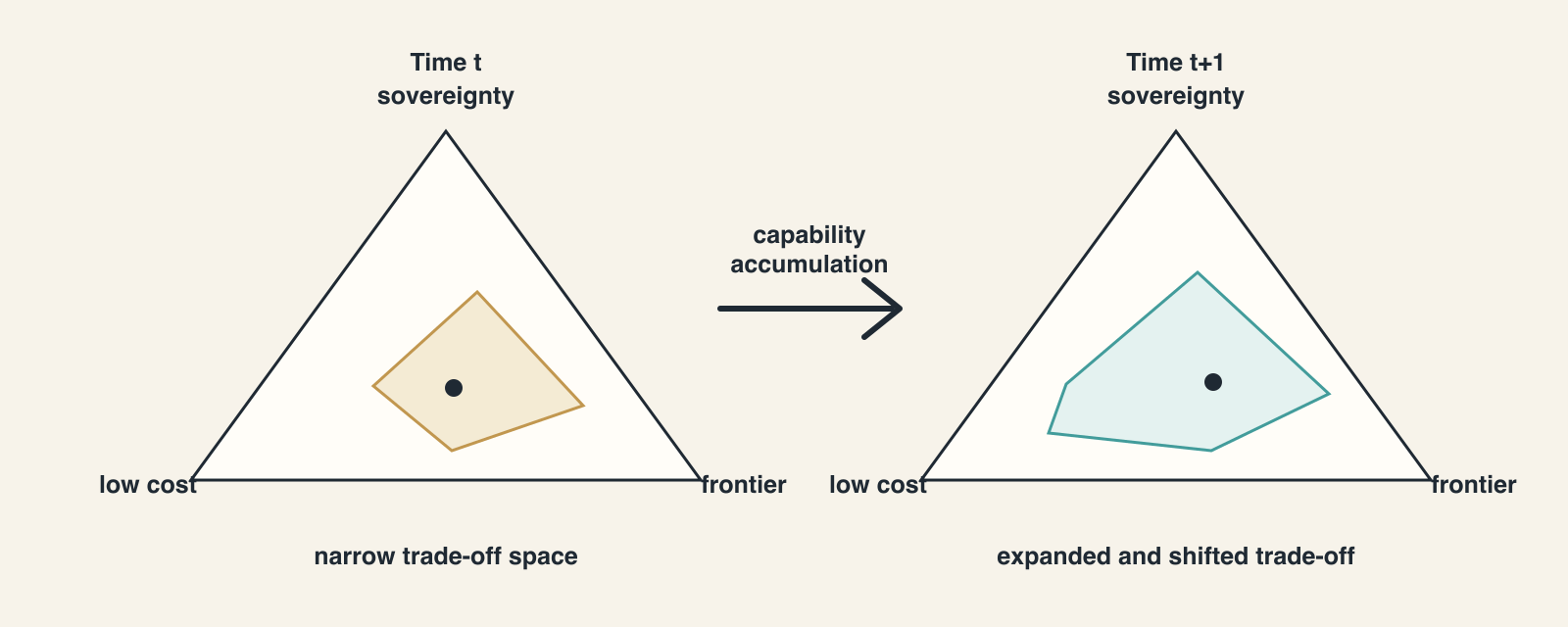
Figure 2: Capability changes tomorrow’s trade-off; announcements leave it mostly where it is.
The earlier Yukti essays were building toward this synthesis. The Stack Beneath the Interface showed why AI capability decomposes by layer. Operational Capacity Is AI Capability showed why evaluation, procurement, and institutional judgment are capabilities in their own right. Capability Formation, Not Technology Adoption showed why access and adoption matter only if learning compounds. The dynamic trilemma puts those pieces together: strategy concerns both where a country sits today and what today’s choices make possible tomorrow. Nowhere is that discipline harder to hold than in India’s current moment.
India’s Selective Route Through the Trilemma
India’s route, in AI and other emerging technologies, is likely to be selective sovereignty: depend in some layers, steer in others, and deepen domestic capability where institutional control matters most. The discipline is to distinguish dependencies that preserve access and learning from dependencies that quietly narrow future choices if they remain unmanaged.
Full-stack control sits beyond any rational near-term ambition. The deepest layers of frontier AI are too concentrated, too capital-intensive, and too exposed to supply-chain and geopolitical constraints. Advanced chips, frontier compute, and hyperscale cloud infrastructure will remain partly external for some time.
External dependence reaches beyond procurement. AI is becoming too important to public administration, health care, courts, and everyday service delivery for all reliance to be treated as interchangeable sourcing. Some dependencies can be managed because they are visible, contestable, and paired with domestic learning. Others become strategic exposure because they shape public systems without leaving enough local capacity to question or repair them.
The IndiaAI Mission reflects this mixed posture. Its official architecture includes compute capacity, datasets, application development, startup financing, skilling, indigenous AI capability, and Safe and Trusted AI. The mission is addressing real access constraints. The strategic test is what forms around the access.
Consider the compute pillar in operation. The mission aggregated demand and empanelled private data-center firms through competitive bidding: by March 2026, 38,231 GPUs had been onboarded through 14 empanelled providers, offered to startups, researchers, and other approved users at a subsidized average rate of ₹65 per GPU-hour, a price the government describes as roughly a third of the global average. Earlier portal materials described eligible users receiving up to 40 percent subsidy on AI compute services. IndiaAI did not build a national GPU cluster. As industrial policy, this is a coordination move rather than a construction project: the state used its position as a demand aggregator to change the price of learning.
Follow the subsidy through a funding cycle, and the distinction between consumption and capability stops being abstract. A startup that trains a model on subsidized compute has, at minimum, consumed cheaper GPU-hours. Capability compounds only if something reusable survives the run: evaluation harnesses that outlast the model, benchmark results for Indian languages published where other teams can reuse them, or data work that becomes shared infrastructure beyond one company’s pipeline.
For a public agency, the same question runs through procurement. The first AI contract is often signed with little internal knowledge of what to specify. The second is better only if evaluation results, vendor records, and failure reports were preserved as institutional memory rather than leaving with the official who managed them. Whether routines like these are required deliverables of public support or incidental by-products is much of what separates capability investment from consumption support.
The subsidy’s real test arrives when it ends. If trained teams, published benchmarks, and procurement templates persist, the subsidy was capability investment. A ministry should be able to write a sharper tender in 2029 because of what it learned running subsidized workloads in 2026. If demand collapses back to the pre-subsidy baseline, the subsidy was consumption support with a fiscal wrapper. Reported under-utilization of the portal’s GPUs in early 2026 shows the question is live. The same test applies to the mission’s other pillars: AIKosha can become usable data infrastructure or remain a portal, and safety tools can enter procurement and certification practice or stay at the level of research outputs.
India’s targeted-leverage strategy extends to 2026 AI diplomacy: the M.A.N.A.V. frame asserts agency over how AI enters Indian society, while the Pax Silica initiative seeks more reliable access, through trusted supply-chain cooperation, to the hardware layers India cannot yet control alone.
Digital public infrastructure supplies a different kind of leverage: steering. Aadhaar, UPI, DigiLocker, and related rails give the state a way to shape participation, interoperability, and data flows across the digital stack. As Digital Public Infrastructure and Its Limits argued, DPI can help organize AI adoption, while chips, compute, frontier models, and institutional judgment remain separate capability problems.
Operational capacity is the layer where selective sovereignty becomes visible inside institutions. A ministry that procures AI systems without audit routines can become dependent even when the vendor is domestic. A hospital that uses prediction without local validation can lose judgment even when the model is affordable. A school board that digitizes assessment without credible recourse can modernize the interface while weakening legitimacy. Generative systems make this harder because plausible outputs still need verification; fluency can hide error, bias, and missing context. Why Technology Is an Institutional Problem made this point through the operating layer: procurement, workflow, oversight, and recourse are where technology becomes institutional.
The matrix makes the selective route visible as a capability test. It asks where durable capability has accumulated enough to change posture, where early build efforts are underway, and where managed access still remains the realistic near-term position. Selective sovereignty works as a layer-by-layer judgment about where India can depend, where it can steer, and where domestic capability has to deepen because the public consequences are too important to outsource casually.
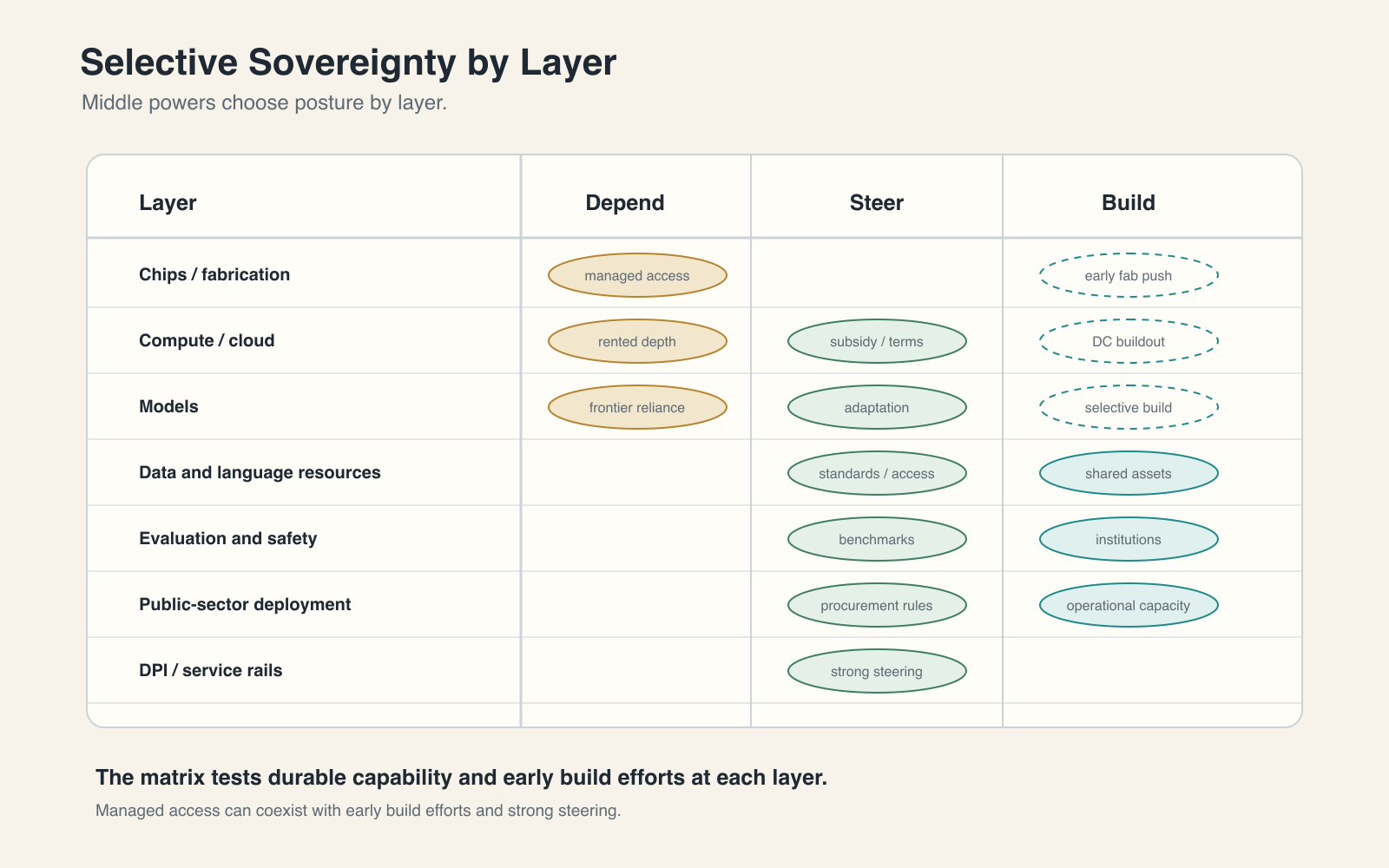
Figure 3: Middle powers choose posture by layer.
The matrix shows that managed dependence in one layer can coexist with aggressive capability-building in another. India can accept managed dependence in frontier chips while building and steering public-sector operational capacity: evaluation routines, deployment competence, data systems, and procurement memory that make future dependence more governable. Selective sovereignty puts ambition where capability can actually compound.
Other Paths Show the Cost
China shows one path through the trilemma: pushing toward control by absorbing very high cost. Its strategy reduces exposure in strategic layers by building manufacturing depth, supplier networks, state-directed industrial capacity, technical universities, and redundant domestic alternatives where foreign dependence looks dangerous.
The control China seeks is especially visible in the industrial base around chips, advanced manufacturing, platforms, data governance, and supply chains. Barry Naughton’s work on China’s industrial policy and Chris Miller’s history of the semiconductor contest describe the scale of that effort and its constraints. China’s path shows that the trilemma shifts through decades of cumulative capability investment; isolated technological wins cannot do the same work. More control requires capital, state coordination, redundancy, and a willingness to tolerate inefficiency for resilience. Even then, control remains incomplete. Advanced semiconductors still expose bottlenecks. Export controls still matter. Equipment ecosystems and process knowledge cannot be replicated instantly. Scale changes how much of the cost of sovereignty a country can absorb. The cost remains.
The European Union shows a different path: steering through market size and regulation. The EU is not at the center of frontier model production, advanced-chip supply, or hyperscale AI cloud. Its assets are market size, regulatory authority, institutional credibility, and the ability to make rules travel through compliance. Anu Bradford’s account of the Brussels Effect gives the strongest version of that logic, though its reach is contested and its domestic costs are increasingly visible. The EU AI Act applies the steering ambition to AI, making regulation a strategic instrument as well as a legal framework. Europe changes its position inside the trilemma primarily through steering rather than control.
Europe pays for steering in compliance burden and diffusion speed. Obligations can weigh heavily on smaller firms and deployers. Standards take time to bargain over. Rule-making authority does not by itself create frontier industrial depth. The Union has already paid part of that price in public: in 2026 it agreed to delay the Act’s high-risk obligations and extend simplifications for smaller firms, after sustained pressure over compliance costs. Governance leadership is real technological power: it shapes how firms document systems, classify risks, and prepare for market access. Regulatory influence can shape deployment while domestic frontier leadership still lags.
The United States sits differently because much of the frontier lies inside its firms, capital markets, cloud infrastructure, and legal jurisdiction. Its problem is not how to access the frontier from outside, but how to protect, power, finance, and govern a frontier it substantially hosts. Even there, sovereignty and access carry costs. Export controls, industrial subsidies, power constraints, and supply-chain reconfiguration are all signs that frontier access has acquired a strategic cost.
The comparison clarifies the cost structure. Control absorbs capital, redundancy, and inefficiency. Steering depends on institutional credibility and market leverage. Dependence buys speed but creates exposure. Middle powers face the harder version: choosing which layers to deepen, which to steer, and which to access. A further question then becomes unavoidable: whether any of this still matters once the great powers start forcing choices.
Alignment Is Not the End of Strategy
One response says the middle-power problem has become simpler. If technology stacks harden, if access becomes conditional, and if hedging is punished, then middle powers should choose the larger system that offers the best shelter from their gravest threat.
The alignment-first view sees something real. Great powers are no longer merely offering access to markets, finance, chips, and security. They are using the systems they command to sort other states into more disciplined relationships. A middle power may control a useful node: a resource, a market, a dataset, an institutional niche. A node that can disrupt a system still lacks command over the system itself.
A harder hierarchy changes the terms of strategy. It does not end capability accumulation. Alignment takes several forms. A country can align as a buyer of protection, as a useful node in a larger system, or as a capable partner whose institutions, firms, and operational competence make it harder to ignore. Accumulated capability, more than diplomatic language, separates those postures. Aligned access can also accelerate capability, when partnership transfers knowledge, industrial participation, and institutional experience beyond finished systems.
AI makes capability-based alignment especially important because the technology enters society through ministries, hospitals, courts, regulators, and procurement systems as well as frontier labs. Evaluation capacity, procurement competence, and operational judgment give middle powers a way to turn access into bargaining position and avoid passive integration.
Middle powers face the trilemma most sharply because all three objectives remain necessary. They need frontier access for learning, enough sovereignty to avoid strategic exposure, and low-cost efficiency for broad diffusion. Pursuing any one carelessly weakens the others. That is why the useful question about any single move is what it does to the moves that come after.
The Political Economy of Capability Formation
Control, steering, and dependence are outcomes of capability, but they are also inputs into future capability. A country can depend in ways that teach or in ways that hollow out local capacity. It can steer in ways that build institutional authority or produce symbolic standards nobody follows. It can seek control in ways that create durable industrial depth or waste public money on isolated assets. The useful question about a national model, a cloud partnership, a compute subsidy, or a regulatory regime is what it does to the country’s next set of choices.
Ordinary institutional routines determine whether access teaches or hollows out. Ministries have to fund maintenance after announcements. Universities have to train for judgment alongside tool use. Regulators need technical credibility. Public agencies need to preserve evaluation results, vendor lessons, and failure reports across official postings. Firms have to invest beyond import-and-integrate business models if domestic capability is to compound around access.
Capability-building and dependence organize around different coalitions. Capability-building routines are slow, cumulative, and institutionally dispersed. Dependence is transactional, contractable, and often paid on short cycles. In many procurement systems, a cloud reseller can earn its margin even when the client’s engineers learn little from the workload. A consulting firm can be paid to integrate a system, not to train its client out of needing integration. An official may earn credit for an inauguration within a posting cycle of a few years; a capability program pays off in ten, under someone else’s name. The political economy is asymmetric: dependence has organized beneficiaries today; institutional depth has dispersed beneficiaries tomorrow.
The coalition for dependence often speaks in the language of the trilemma’s third pillar. Imported integration is faster, cheaper, and easier to justify inside a short policy cycle than slow institutional depth. The coalition for capability asks for slower investments whose returns arrive later: knowledge transfer, open standards, reusable benchmarks, institutional learning, and procurement memory. Low-cost efficiency is a real objective, but it also becomes the argument incumbents reach for when capability formation threatens their contracts. A country can remain dependent with ample talent and ambition when the coalition that benefits from dependence is stronger than the coalition that would build its way out.
India can attempt selective and temporal strategy because the country has some negotiating surface: scale, technical labor, public digital rails, strategic geography, and relationships across more than one technology bloc. These assets will continue to matter only if capability compounds around them.
For middle powers, dependence on global systems will remain necessary where access matters more than immediate control. Domestic depth should be built where dependence would block learning, weaken bargaining power, or expose essential public functions. Public infrastructure and regulation can steer markets where the state has leverage. Operational capacity matters where public institutions must evaluate, procure, audit, and contest AI systems. And capability formation has to compound across repeated procurements, deployments, and institutional routines.
Sarvam will matter less as proof that India possesses sovereign AI than as evidence of whether India is becoming more capable of exercising sovereignty over time. The question is whether one well-funded company becomes a site of training, evaluation, deployment learning, and ecosystem spillover, or a proof point in a story about arrival. The same test applies to compute subsidies, public rails, safety institutes, and cloud partnerships, and it will keep applying, case by case, as AI settles into hospitals, courts, classrooms, and ministries.
No country escapes the trilemma. The objective is to invest so that tomorrow’s trade-offs arrive less severe than today’s. The frontier can be leased for a while. Capability cannot.
Visual note: The diagrams in this essay are original Yukti visuals, designed from the author’s briefs and produced with AI-assisted code generation, then reviewed before publication.
Earlier Essays
The Stack Beneath the Interface on why AI capability has to be read layer by layer.
Operational Capacity Is AI Capability on why evaluation, procurement, and institutional judgment are forms of AI capability.
Digital Public Infrastructure and Its Limits on where public rails can steer AI adoption, and where they cannot.
Capability Formation, Not Technology Adoption on why access and adoption become strategic only when learning compounds.
Why Technology Is an Institutional Problem on why procurement, workflow, oversight, and recourse shape what technology becomes.
Further Reading
Tony Blair Institute, Sovereignty in the Age of AI — the Control / Steer / Depend typology this essay extends in time.
Collective Intelligence Project, Solving the Transformative Technology Trilemma through Governance R&D — a different trilemma, focused on progress, participation, and safety at the societal level; adjacent to the national-strategy trilemma here.
Alexander Gerschenkron’s Economic Backwardness in Historical Perspective, Alice Amsden’s Asia’s Next Giant, Sanjaya Lall’s Learning to Industrialize, and Robert Wade’s Governing the Market — classic development literature on late industrialization, state discipline, technological capability, and learning under constraint.
William Baumol’s “Entrepreneurship: Productive, Unproductive, and Destructive” — background for the political-economy point that incentives shape whether talent and enterprise become productive capability or rent-seeking activity.
Barry Naughton’s The Rise of China’s Industrial Policy, 1978 to 2020, Chris Miller’s Chip War, and Anu Bradford’s The Brussels Effect — background on China’s industrial-policy path, semiconductor chokepoints, and EU regulatory power.
September 2025 GITAM-KSPP lecture slides on the AI trilemma — an earlier AI-strategy version of the trilemma; this essay generalizes the frame across emerging technology strategy.
Sources and Case Materials
IndiaAI Compute Portal, AIKosha, and public-sector AI competency initiatives
PIB release on AI compute capacity and data-center growth, March 2026
Economic Times on reported under-utilization of IndiaAI portal GPUs
ISRO archived page on the GSLV-D5 indigenous cryogenic stage mission
Council of the EU on the 2026 AI Act simplification agreement
Federal Register rule on 2022 U.S. advanced-computing and semiconductor export controls
State Department statement on 1992 ISRO-Glavkosmos sanctions, Lok Sabha Debates, May 10, 1995, and Federal Register Vol. 57, No. 97, p. 21319 (May 19, 1992) — primary trail for the cryogenic-engine transfer episode. See also Gopal Raj’s Reach for the Stars.